Kitesurfing Waddell was hard on my body and ego. There are extenuating circumstances: windsurfing is my passion and kitesurfing is something I do to spend more time on the water (see Windsurfing Theory); I’ve windsurfed for 40 years and kitesurfed for 4; I had previously only kitesurfed in gentle knee-high Florida waves. Obviously my experience was going to be very different. And so it was.

The chosen day was typical Waddell, overhead close-out waves and cross-shore winds, but too light to windsurf. One lonely windsurfer was struggling in the shore break while dozens of kitesurfers zipped around effortlessly (so it seemed). And so with a keen sense of foreboding gripping my chest, I rigged my kite, grabbed my board and prepared to launch.
Wave sailing with a kitesurf works the same way as with a windsurfer (see Windsurfing Theory) with a few a small differences that make it both easier and harder. The kitesurf board is smaller, more like a regular surfboard, so it maneuvers better, making it easier to find the right position on the wave. The kite itself, floating high overhead, is lighter in the arms, lifts you over the waves, and offers unobstructed views. You can also ride a kitesurf backside (backside against the wind) or frontside (knees against the wind), which lets you surf in your favorite position even when the wind blows from the wrong direction, something that’s impossible on a windsurfer (this one’s hard to visualize, so you’ll have to believe me). So far so good.
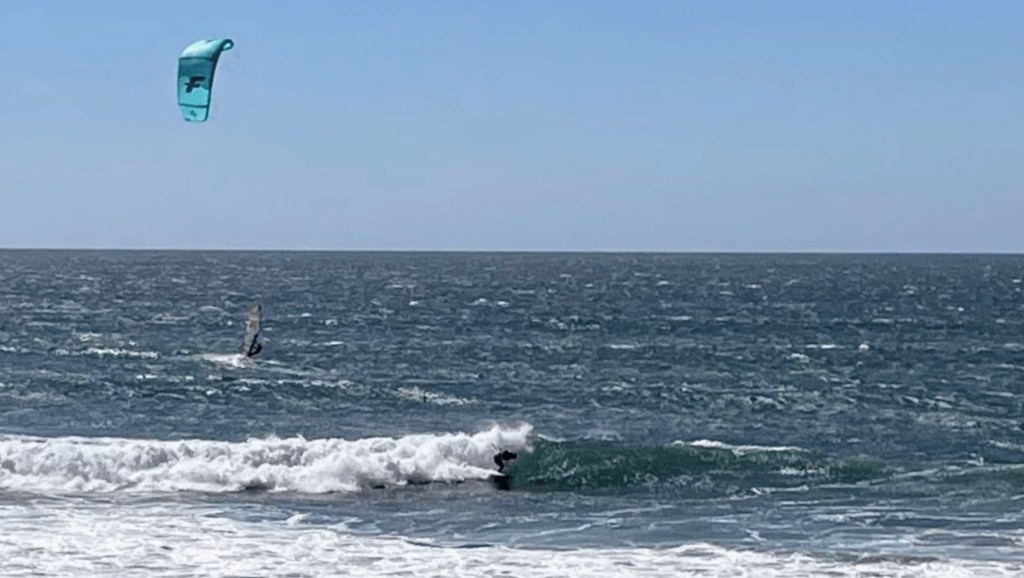
The kite is separated from the rider by 24 feet of line, so there is a consequential and sometimes calamitous pause between wanting and experiencing a change in direction. In the maelstrom of wind and waves, delayed gratification does not pay off. Anticipation is key and this is a learned skill that I had yet to learn. Also, my kitesurf board has no foot straps, just like a regular surfboard, which makes keeping ones feet on the board, while being pulled by the kite, while keeping the board on the wave face, challenging. This is different from twin-tip kiteboards most people ride on flat water, which have foot straps for tricks and jumps. My board is for wave sailing, or so I thought.
As it happens, most kitesurfing boards at Waddell have foot straps too. This is a local kitesurfer adaptation to the strong winds and big close-out waves, helping them pull out of difficult situations quickly and safely. The boards are also much narrower, designed to handle the high speeds of steep waves. A poor craftsman blames his tools and I shamelessly blame my board!
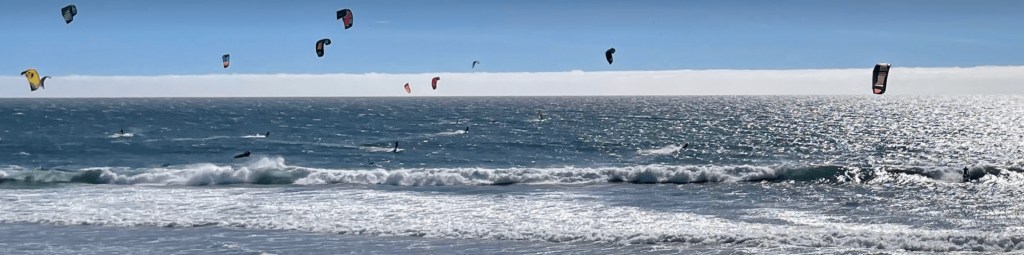
And so there I was, at water’s edge, facing the thunderous Pacific waves, my light-wind Florida board underarm, and my kite overhead gently nudging me out. What could go wrong?
A kite generates much more power than a windsurfing sail, so powering over waves is not a problem. But I still have to push my board over house-high whitewater rushing towards me at over 30 mph (the combined speed of the wave coming in and my slow-as-possible speed going out), without foot straps. Frequently, propelled into the air, my board would fall behind the wave, leaving me suspended momentarily, before being plunged into the water, for the next wave to come crashing through, sending my board cartwheeling to shore, which I followed in hot pursuit, pulled by my kite, to then start all over again.
Sometimes I made it out, and then I had to make it back in. I had no problem catching a swell, but I couldn’t keep up. Even pushing my board to maximum speed, its too-wide tail bouncing and bucking, the swell would pass relentlessly under me, and glancing back over my shoulder, I would line up for the next swell and ride that for a bit, and so on until the swell finally slowed and pitched into a wave, and then regularly pitched me over as well, the board dropping from my feet down the face, the wave crashing over my head, the kite whirling directionless as I tumbled underneath.
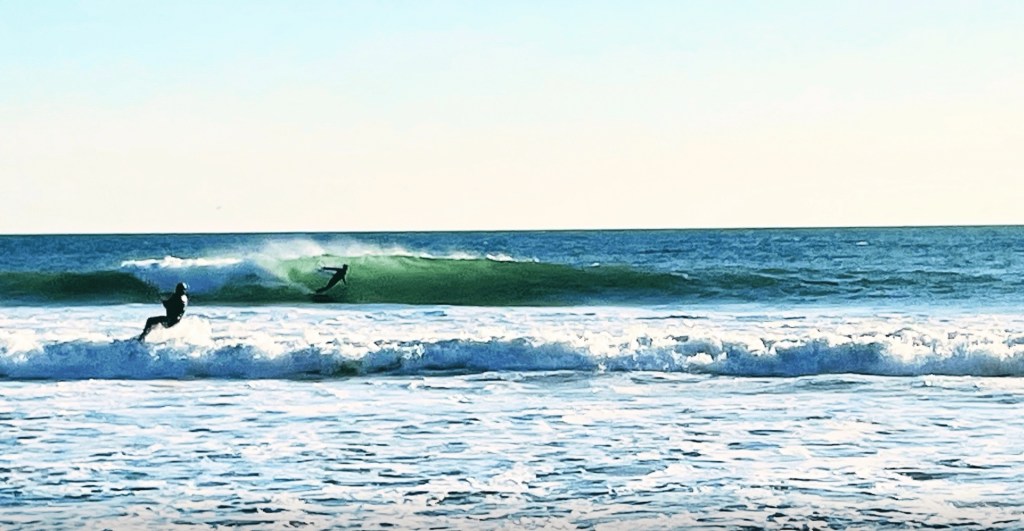
Sometimes I happened to be in the right place at the right time, early enough on the wave to ride the face before it breaks. And then the beauty of kitesurfing becomes clear, with my kite comfortably parked above so it no longer pulls, my board perfectly embracing the curves of the wave, and me, crouched and poised, inches from the wave breaking around me. Even for a beginner, kitesurfing can bring you big-wave surfing sensations that would take decades to master on a surfboard.
So I’ll admit that for me, kitesurfing is not only about more days on the water. It’s also about the bravado of taking a surfboard where few surfers can go. It’s humbly asserting myself in a challenging environment and finding a sense of peace, of love, when everything lines up perfectly, as it almost always does eventually and mostly unintentionally.
 F4 Plus