My trip back from California was uneventful. Join the I-10 in Los Angeles, a few miles from the Pacific, and leave the I-10 before you hit Jacksonville, on Florida’s Atlantic coast. I took my time but still managed to cross Texas in one day, 900 miles from El Paso to Beaumont. Things to be thankful when driving through Texas: 80 mph speed limit, cruise control, Abba soundtrack. Now to next the destination…
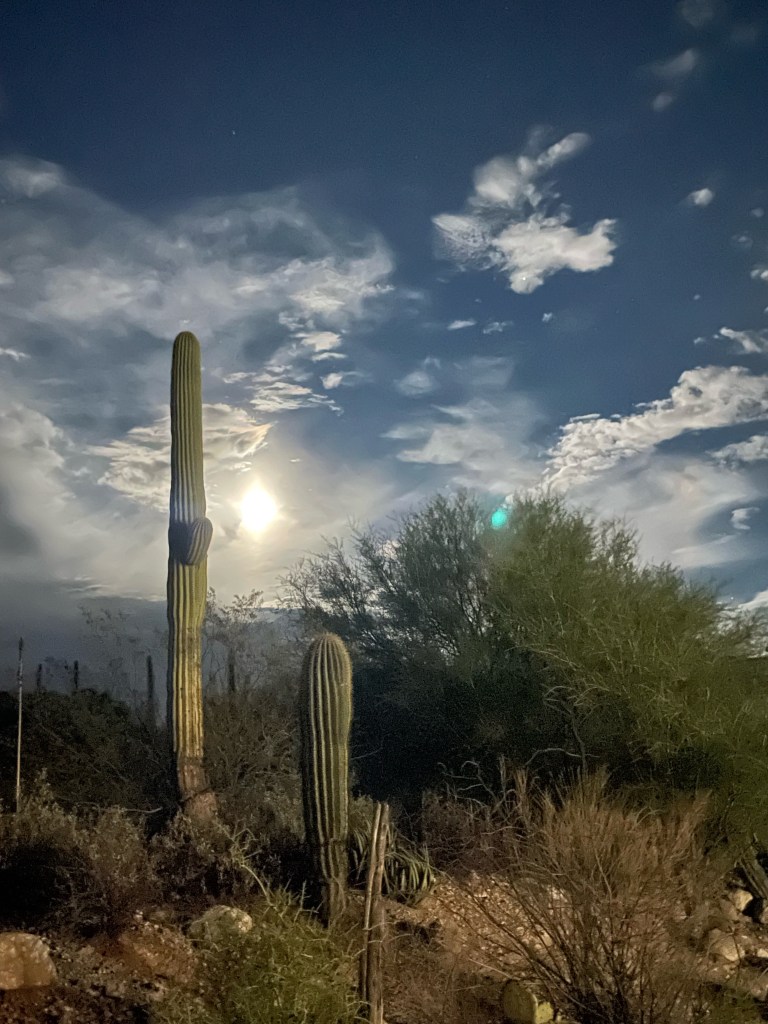
Only a few special places in the world have the ideal combination of waves, wind strength and wind direction for wave sailing (see Windsurfing Theory), and then only for a few months, when meteorological conditions come together perfectly. Finding these places takes study and travel.
Wind is a form of solar energy. The sun heats the Earth unevenly which creates a pressure gradient that moves the air between regions (like steam escaping a boiling kettle). The Earth’s rotation (Coriolis effect) and landscape then transform that energy into the wind’s many forms: storms, thermals, trade winds, sea breezes; and all their local versions: Hurricane, Typhoon, Foehn, Sirocco, Northeasterly, Chinook, Santa Ana, Monsoon, Mistral, Meltemi, Ponente, Levante, and so on.
I’m looking for wind that creates waves and wind to windsurf, and they are usually different. Good waves are created by powerful winter storms in the northern or southern oceans, when the temperature difference with the winter pole is at its maximum. The swell travels thousands of miles, so those waves will reach me as long as I’m on a beach facing an ocean. There are thousands of beaches with good waves enjoyed by millions of surfers. Good waves are not hard to find.
Wind to windsurf is best when it’s consistent, which storms are not (they come and go). Consistent local winds are created by pressure gradients from local temperature differences. A common example is an afternoon sea breeze when the summer sun heats the land faster than the water. To windsurf though, these winds need to be much stronger than your average sea breeze, and that’s rare.
The highest temperature differences outside of the polar regions (a bit chilly for water sports) occurs during the summer months where hot deserts sit beside cold oceans. The big deserts are on the west coast of major continents (also a result of the Earth’s rotation), around the mid-level latitudes of the North and South Hemispheres: North America (California desert), South America (Atacama desert), Africa (Sahara), South Africa (Kalahari desert), and Western Australia (Outback). The deserts in India and Persia sit next to the warm Indian Ocean, so don’t generate much wind. There are several strong local summer winds in the Mediterranean, but that sea doesn’t generate good waves, so I crossed it off the list.
Unfortunately this magical heat effect is easily disrupted by local weather. The main culprit is local storms that bring cooler air and disrupt the pressure gradient. These are infrequent in summer but I’m sitting here in Chile as I write this chapter facing a two week wind hiatus caused by storms over Brazil and Argentina, so they happen enough. Sometimes, the summer wind pattern work too well, creating winds that are so strong they form an eddy. These eddies are just like the ones you see in rivers, where the current loops back on itself when it hits a protruding object, like a rock or a log, except the protruding object for a wind eddy is a cape or peninsula and these eddies can be hundreds of miles wide. The result is weak winds until things get back to normal.
And then there’s Hawaii, which has excellent waves but no desert or cold ocean. Instead, it has trade winds. These winds are created primarily by the rotation of the Earth on either side of the Equator. They are typically too light to windsurf, but in Hawaii they strengthen in summer, and when they pass through Hawaii’s high volcanic mountains (Venturi effect), strengthen enough to create some of the world’s best windsurfing on a couple of beaches (it’s that localized!).
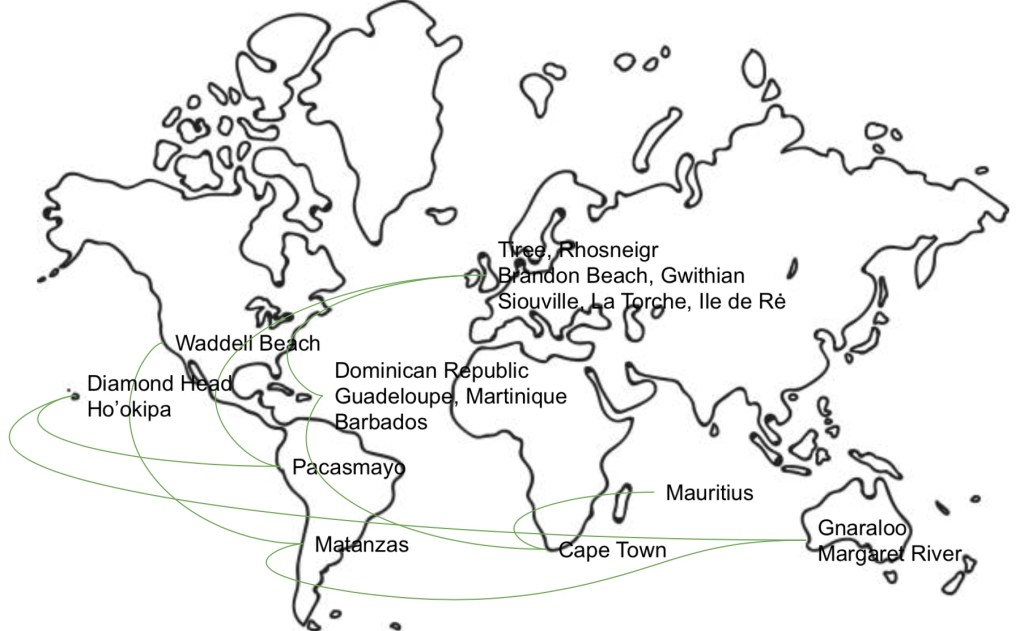
I started my trip in North America the summer of 2022, and Waddell Beach in California was the most convenient first stop, even though the wind blows from the right, the wrong way for my goofy foot surfing. The other stops are not so close but get their wind from the left.
When summer ends in the Northern Hemisphere it starts in the Southern Hemisphere, and in the spirit of the Endless Summer (iconic surfing movie), with the winds winding down in Waddell, it’s time to head south to the (very) small village of Matanzas, three hours from Santiago, in Chile.
From there, with the Southern Hemisphere summer still in full swing, I go to Margaret River in Western Australia, and then up north a dozen hours to deserted Gnaraloo, on the edge of the Outback.
Then to Diamond Head, Oahu, for the start of the summer trade winds in the Northern Hemisphere, including a quick hop to Ho’okipa near the village of Paia, on Maui, the official Mecca of windsurfing and a required place of pilgrimage, even if the wind blows from the wrong side for me.
Then to Peru at the start of their spring, where the wind patterns are a little more confusing (maybe because it’s closer to the equator), in the small village Pacasmayo ten hours north of Lima, which has the world’s longest windsurfable wave.
And then an exception to the summer wind rule. By October, the west coast of Europe is being regularly battered by southwesterly storm winds. The weather is terrible, which brings strong waves and wind, but the water is not winter cold yet. Starting in the north and driving south as the weather turns colder, to Tiree, a speck of an island in the Hebrides, off the coast of Scotland; Rhosneigr in Wales; Brandon Bay, on the southwest tip of Ireland; Gwithian in Cornwall, England; Siouville and La Torche in Brittany, France; and Ile de Rė near La Rochelle, France.
Then back to warmer climes in the Caribean where trade winds are strongest in the winter, but not strong enough to windsurf. They are, though, strong enough to kitesurf, and the excellent winter waves from the North Atlantic storms make a few ocean-facing islands perfect for an exclusively kitesurf island-hopping trip: Dominican Republic, Guadeloupe, Martinique, and Barbados.
Then back to the Southern Hemisphere for Cape Town, South Africa, which has a reputation for the strongest summer winds of all. That only leaves Morocco in West Africa which gets excellent summer winds, but I’ve windsurfed there before and, like California, the other windy west coast in the Northern Hemisphere, the wind blows from the wrong direction for me (and by now, I’m spoiled).
That rounds out the planned itinerary, and if things go to plan (which they won’t, but it’s always fun to plan, and they might), it will be mid 2024. That’s when I would like to visit Mauritius, off the coast of Madagascar in the Indian Ocean, where strong winter trade winds (their winter) combine with perfect waves from the Southern (Antartic) Ocean to create One Eye, the most beautiful left-breaking windsurfing wave. A few years ago I was lucky enough to sail that wave one time, for just 15mn (there’s a story behind that), and sailing it properly would make the perfect end to a perfect trip.
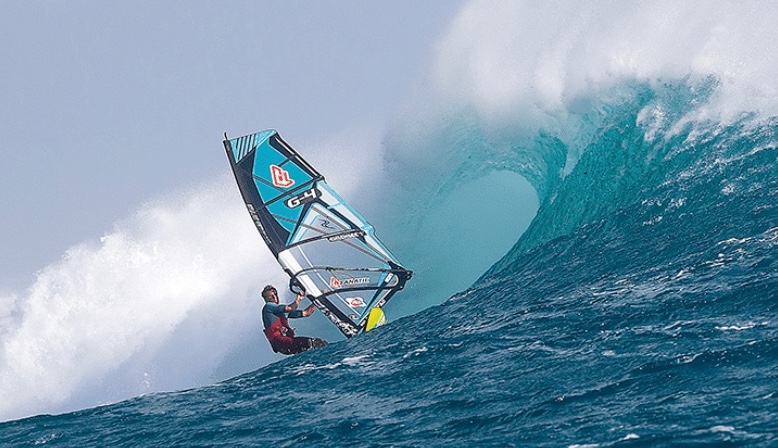
This trip is not all fun and games. It’s also a journey of personal reflection to find with a better version of myself. The steps of self discovery are well known: freedom from distractions, realization of an inner life, learning to feel, identifying and grieving past hurts, living with emotional pain, setting healthy boundaries, meeting personal needs, experiencing a true self, working through core issues, accepting unconditional love, and ultimately finding a higher meaning. It’s a lot and I’m fortunate to be well supported by family and friends. And it takes time, a not-so-simple matter of appropriate prioritization.
 F4 Plus