I came to Matanzas because it has excellent wave sailing for windsurfers. How good? On my first day, not-so-fresh off an overnight flight from Miami and a three hour drive from the airport, I was on the beach chatting with a local windsurfer, mother of two boys in their twenties, also windsurfers. I introduced myself, and she smiled, replying that she knew another windsurfer called Morgan who stayed with her when he visited. I joked that it probably wasn’t Morgan Noireaux, three-time winner of the Aloha Classic, the world’s most prestigious wave sailing competition held annually at Ho’okipa in Maui, Hawaii. But it was. And he visits regularly. The place is that good!
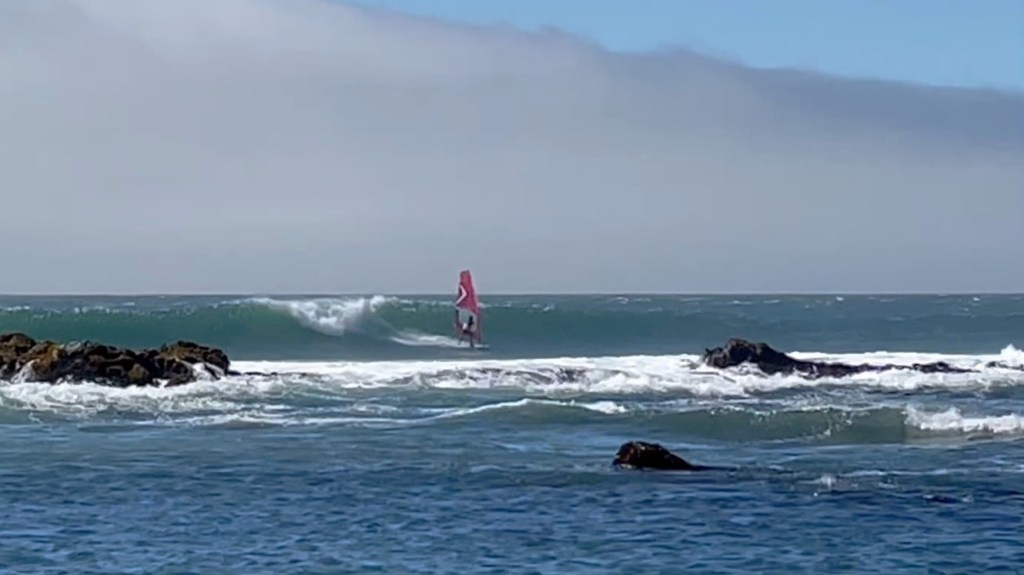
What makes a perfect wave sailing spot for me is a left-breaking wave (because I surf goofy foot, left foot on the back of the board), strong winds that blow down the line (parallel to shore, from left to right), and an easy way out through the waves. Matanzas scores well on all three, while still being extremely challenging, and therefore (perversely) rewarding.
First the wave. It rolls in from the Pacific as a well-ordered swell, heaving past the rocky headland on the far left side of the beach, then majestically curls from left to right, with perfect power and form, over 200 yards (and twice that when the wave is big) until it dissipates gently into a deep water channel.
To catch the wave, you have to windsurf out past the channel, over the breaking waves, and then angle upwind to the left so you can turn onto an incoming swell, and ride that in until it breaks close to shore. The wave riding rule in Matanzas is that the person closest to the curl owns the wave (this is a common rule where waves break evenly in one direction, unlike Waddell). That means squeezing to the left as much as possible. Unfortunately, all the way to the left is also where the rocks are, so you end up catching the wave directly in front of a major rock outcropping, where you definitely don’t want to fall.
That outcropping is both a curse and a blessing. It’s scary, flying down the wave face at 30 mph towards a rocky wall only a few yards ahead. When the wave is bigger, it breaks further out, but then you’re dealing with a more powerful wave that’s pushing you in that much faster. And the rocks create a massive wind shadow that twist the strong winds into a wild mix of fitful gusts and fickle lulls, leaving you guessing about how much sail power you can count on. But the wind shadow also protects the wave, transforming the swell’s choppy surface into a wave face that is silky smooth. The board suddenly stops bouncing and you can focus completely on the first crucial bottom turn, carving through the water effortlessly past the rocks and into another perfect wave ride.
It’s difficult to describe what a smooth wave face feels like, but I’ll try: it feels like waterskiing on a smooth lake with just a hint of ripple from a light breeze; it feels like carving first tracks on a snowboard in fresh deep powder; it feels like running your hand over a clean, crisp and tightly tucked bedsheet. It feels safe and exhilarating at the same time, completely in control. Or so you hope.
Unlike the wave, the wind is the opposite of smooth. It’s too weak on the inside and too strong on the outside. You launch from the beach, which is a deep bay surrounded by bluffs where the wind is mostly absent except for an occasional unpredictable gust. Since you’re on a very small board made for strong winds and waves, you have to teeter out, balancing precariously through the messy waters of the channel, a powerful rip pulling you quickly away to the right of the bay where an old sunken pier bares it’s black jagged stakes. With the help of a passing wind puff and vigorous sail pumping you can generate some forward momentum, and 100 yards out, you’re in the breaking waves.
This is the crux of the ride, the hardest part. The gusts of wind are becoming more frequent, but there’s still a lot of dead air. And now you’re facing down mountains of incoming whitewater. There’s an art to letting the foaming water lift the board, which is barely moving, up and over without being tripped up or sucked under, or both. It’s an art the locals have mastered, but even then it’s no more than fifty-fifty, and much less on a big wave day. And when you’re down you’re usually down for a while, waiting for enough wind to pull you up, pushed back by relentless waves, ending up in the channel carrying you far down the beach.
Timing the sets like at Waddell doesn’t work here; you don’t want to be hanging out in the fast-moving channel waiting for a pause in the waves, and the wind is too inconsistent to know how long it will take to get out. What works well is a lucky gust. Catch one that is strong enough and long enough and you power through the waves in seconds. Simple.
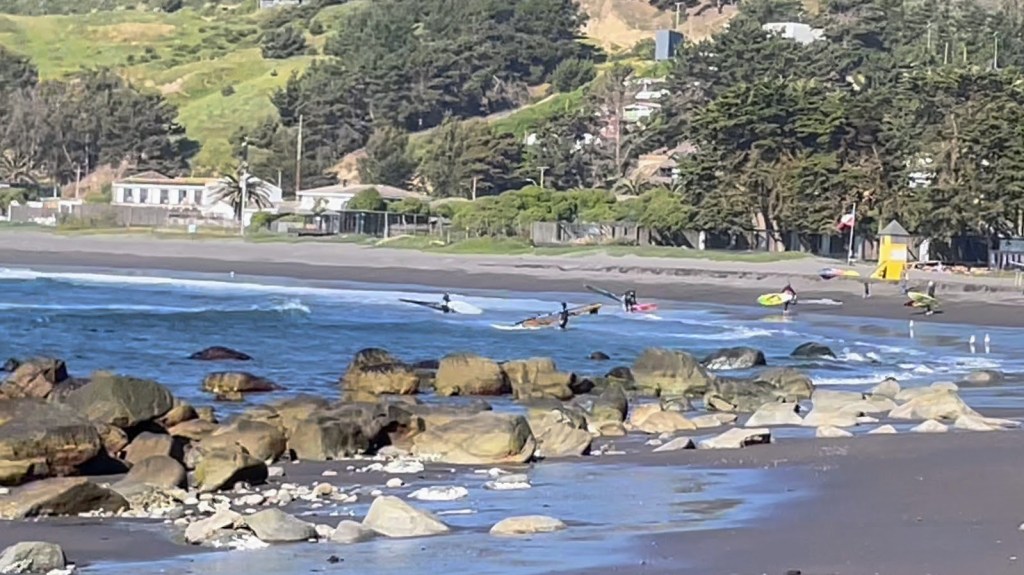
Past the break and you’re in the open ocean. Somehow it feels bigger here than in California, maybe because there’s not much behind, just a lot of empty hills. It’s also windier, which makes it seem wilder. 35 mph winds (30 knots) are usual, and more in the gusts, sweeping over massive swells steaming north on the fast-moving Humboldt current. Even in the company of a dozen windsurfers and a couple of kiters you feel very alone, very small. We’re all on the same circuit, pinching upwind to set up for the next wave, scouting the best swell, and catching the wave as close to the rocks as we dare. Everyone wants their own wave, so we place ourselves in sequence, like on a racetrack. From afar, it all looks very orderly.
The last few yards before the wave breaks are crucial. Is the wave worth riding, or is the next one better (hit the brakes and wait)? Are you alone, or at least upwind of anyone else? Will the wave break early or late (how much room before hitting the rocks)? Is it breaking cleanly from left to right, or will it break in the middle as well (prepare to pop out the back of the wave or hit the breaking section for an explosive final top turn)? Is the wind flagging (rely on the power of the wave) or is there a friendly gust (use the power of the sail as well)? Now you’re ready to go, and you commit; we’re never so free as when all the choices have been made.
And then it’s a series of fast bottom turns and faster top turns, the board carving sharply on the wave face as long as the wave holds up, hurtling down the line before finally dumping you into the channel where, exhausted from the ride, you attempt a windless and precarious about-face to sail out once more.
This is just beginning. As yet I’ve only sailed Matanzas a few days. Nearby, there are other breaks you can only sail in special conditions, talked about with awe (local tales). There is much more to discover. It is presumptuous of me to think that I will capture the full Matanzas windsurfing experience in just a few weeks of passing fancy. Some locals have been windsurfing here for 30 years, the same few miles of coastline. Like seasoned fishermen chasing their catch, they read the ocean and sky for the best waves to ride. I’m a dabbler among artists, but it’s enough that I can see their work, see what’s possible, and occasionally, share their experience.

 F4 Plus