I grew up in London on a diet of American movies. Set against grey, dusty England, America was all adventure and riches. There was not much philosophy to be learned from the stream of happy endings (though optimism is a powerfully positive force in America) but I kept a favorite saying, delivered by an American actor of few words, “a man’s got to know his limitations.” This came to mind on day five at Matanzas, the day big waves rolled into town.

Big is subjective (thankfully). For me it means waves over mast high, or 4 meters (13 feet). That’s when my excitement turns to fear. Out there, I’m always a little nervous, which keeps things interesting, but fear is unpleasant, unhealthy and, when self-imposed, unnecessary. Fear is a mental construct. It has the strongest evolutionary origin, survival, which we then repackage in our subconscious with layers of irrational learned behavior that has nothing to do with survival. This presents an interesting challenge; knowing when to step up and when to give up.

Fear of big waves is rational. Water is an alien environment for humans, usually cold, hard to move in and impossible to breathe in. Tumbling in a wave intensifies all of those properties, your wetsuit flushed with cold water, limbs flailing helplessly in the rush while holding your breath for… who knows how long.
Fear of big waves is also irrational. The cold is only a momentary irritation (like jumping into a summer lake); you’re tumbling through water, soft and airy (aside from hitting the bottom, which is easily avoided by picking the right beach on the right tide); and you’re never under for more than a few, if unpredictable, seconds. Logically, there is nothing to fear. There is also a strong incentive to overcome the fear; new skills, new experiences, bragging rights.
And yet fear dominates. Fear is not driven by logic. It’s a lifetime of signals entrenched in the subconscious with the express objective of making fear instinctive, not a considered decision. It’s the childhood warnings about falling in the pool or staying out of the shore break, being dunked by friends longer than you wanted, exhausting yourself on a swim or a dive, hearing about a tragic drowning, or maybe your own near-death experience. Now you’re primed to run away from playing in waves.
Our ability to develop new instincts, a very animal trait, makes short shrift of the world’s complexity by cutting through all the possible options to pick the one that feels right, without thinking. Instinct confers huge advantages when there’s no time to think or when the situation is too complex to analyze. Our very human problem is that even when we take time to consider a decision, our subconscious wrests control of the process to bias the outcome and satisfy its needs. That can be good; studies have shown that gut-feel decisions in business are right 90% of the time. It can also be bad, because your subconscious thoughts are often out-dated, irrelevant, and not even your own.

And so it is with big waves. My subconscious fear comes from old traumas that were appropriate back when I was a weak child learning to survive, but have nothing to do with riding big waves today as a strong adult with years of training. Fortunately, there’s a process for working with the subconscious (those who know me know that I like a process): recognize my subconscious bias, understand the feelings behind the bias, accept that these feelings are from the past, put them behind me (tricky, but there’s a grieving process for that too), assess the current situation without being controlled by those feelings, and repeat until it the bias dissipates. Now I’m facing my fear as an adult today, not as a child years ago. Now I can use knowledge and intellect to think through and objectively consider the risks and consequences. Now my decision is not a fog of confusion and hesitation, but a clear and true direction. You never fully get rid of subconscious feelings, they remain as shadows, but they no longer decide for you.
“Nothing in life is to be feared. It is only to be understood.”
― Marie Curie
Of course, this takes time and introspection (and therapy). It’s something you want to wheel out for the really, really important decisions in your life, like picking friends and partners, fighting (or not) with family, buying a house or a boat or a car or that really nice jacket, changing careers, playing (or not) the stock market, voting, any type of legal action, probably posting on social media too, and, of course, riding big waves. So there I was, on my fifth day at Matanzas, watching the long lines of mountainous swell march steadily towards me and rise into magnificent glittering wave faces swept clean by the wind and beautiful ridden by the local hot shots, anxiously considering my options, thinking to myself, “this could be heaven, or this could be hell…” (the title of that song was my cue).
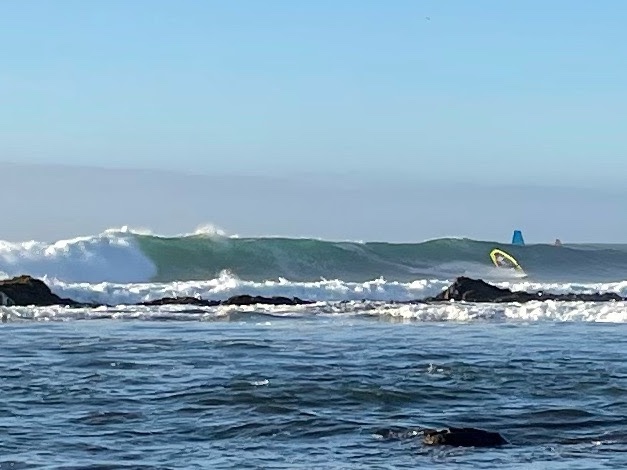
And I decided to sit out the day. And it was hard (hence this drawn-out mea culpa). And it was the right decision because I didn’t have enough information to make the right decision. I was too new to the place, had not sailed in enough conditions, did not even know who to ask. I was left with either the arrogance of blindly ignoring my fear, or acknowledging that overcoming fear is a process that takes work. Which is what I’ve been doing these past weeks, riding waves of difference sizes, learning the changes in tide and wind, checking in with the locals, and most of all, getting comfortable with wiping out and long tumbles under water.
“The brave man is not he who does not feel afraid, but he who conquers that fear.”
― Nelson Mandela
A big swell is forecast for this weekend. I’ll be there. I’ll let you know if it’s only to take pictures.
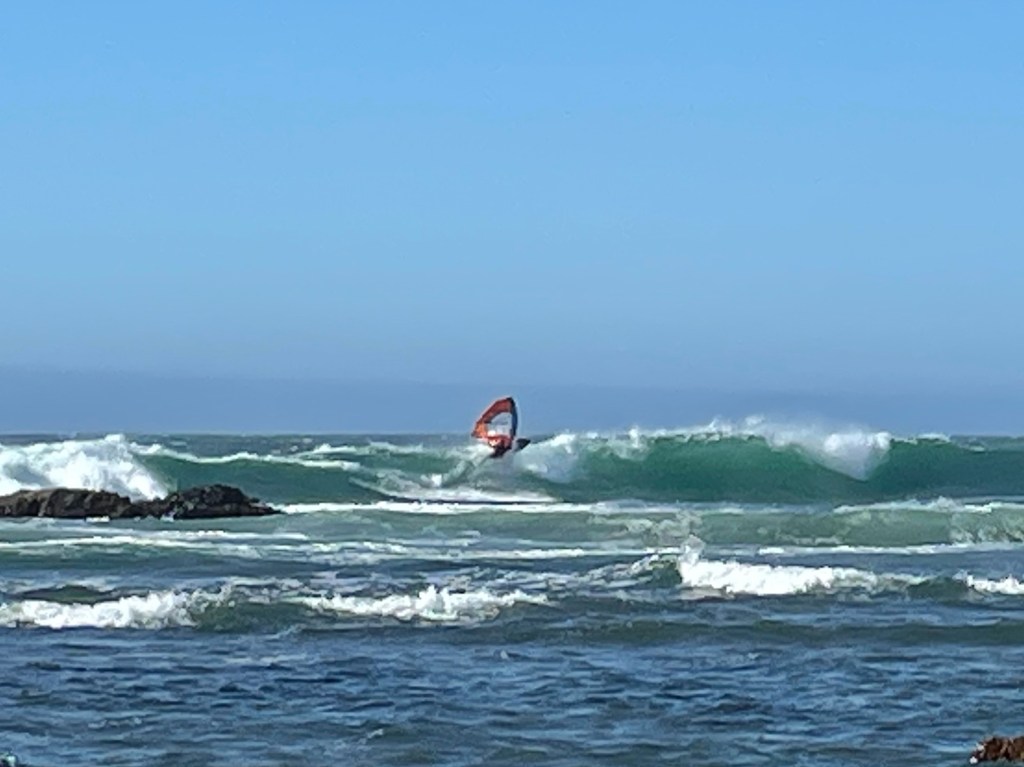
 F4 Plus