The wind was not cooperating in Matanzas, Chile, so I consulted the weather maps and drove a few hundred miles south, deep into Mapuche territory. The Mapuche make up the vast majority of Chile’s indigenous inhabitants, mostly living in southern Chile, an area they call Wallmapu. Unable to conquer the Mapuche, the Spanish colonialists and then independent Chile declared Wallmapu an autonomous nation, a region rich in agriculture and trees. And therein lies the perennial problem. By the end of the nineteenth century, Wallmapu was annexed by Chile, the Marapuche were forced off their land and vast forestry franchises granted to outside interests to exploit the lumber. The Mapuche have waged a continuous low-intensity war to reclaim what was theirs, more recently escalating into frequent acts of sabotage against forestry companies, the occasional torching of land owner homes and businesses, and a small number of highly-publicized deaths. The government reacted with force, deploying a heavily armed military presence.
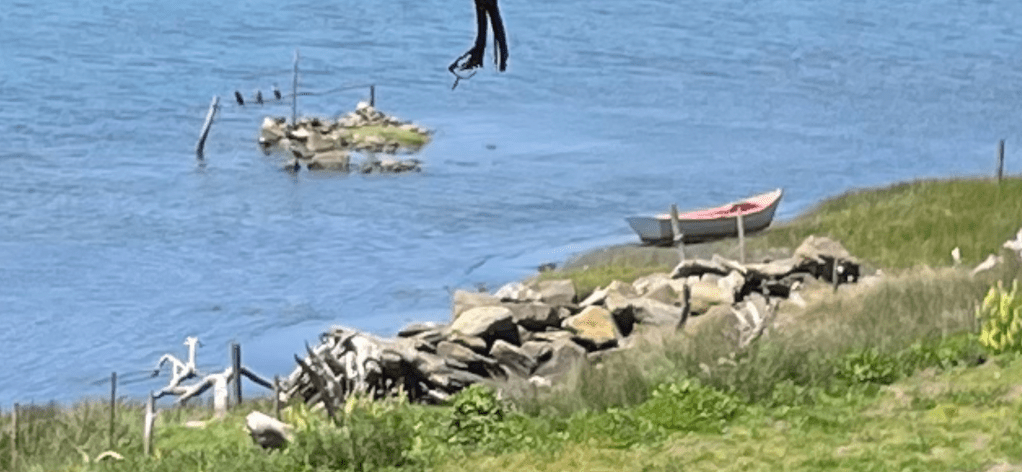
Driving into beautiful Wallmapu, reminiscent of the Pacific Northwest, with dense dark forests blanketing steep ravines cut by peaceful lakes and rivers, there was little sign of the conflict, except for the occasional urban assault vehicle incongruously parked in a village square, and the ubiquitous “FUERA” (get out) graffiti on government property, principally the equally ubiquitous rustic “Parada” (bus stop). Oh, and a steadfast stream of logging trucks plying the winding roads, tormenting the locals.
Driving 10 hours doesn’t get you very far in Chile. I covered less than 10% of the 4,000 mile (6,500 km) coastline, but enough to find the wind I needed. Narrow, slow, potholed roads take you to Ruta 5, Chile’s main North-South artery, and then it was smooth sailing, majestically accompanied by snow-capped Andes mountains outlining the eastern horizon. The highway infrastructure is good, but you need to stay sharp. A few things to look out for: those ubiquitous bus stops (even on the highway), taxis dropping off their fares on the shoulder, said fares darting across four lanes of speeding traffic, cyclists, and tractors.
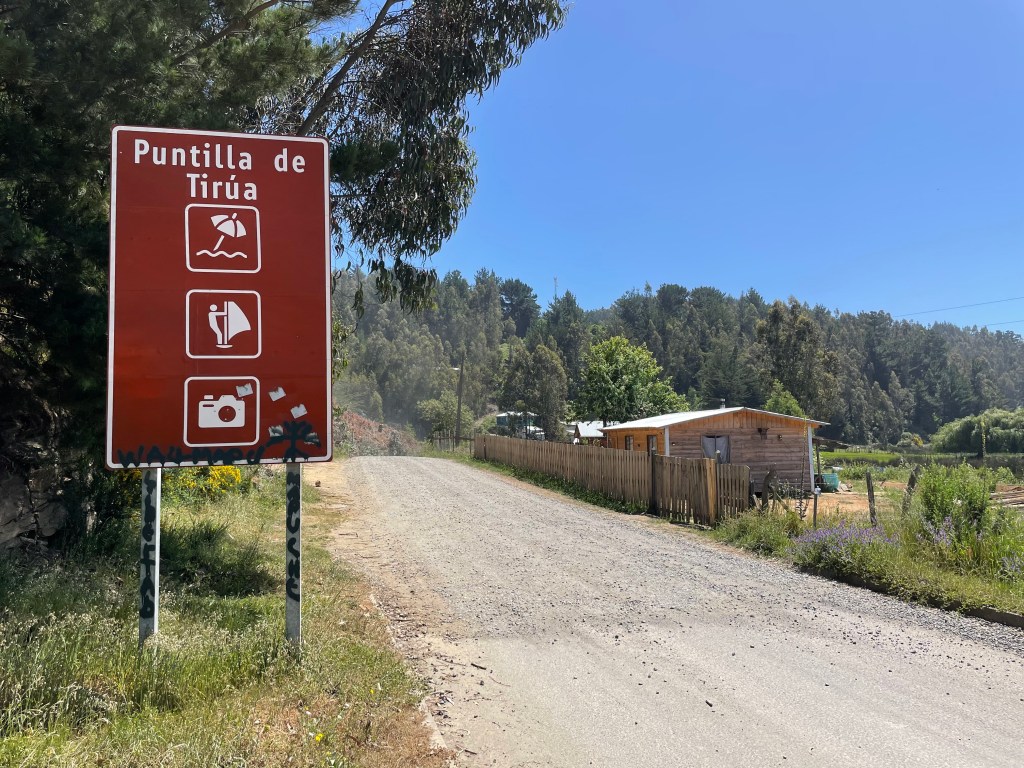
I ended up in the small fishing village of Tirúa. I found excellent, challenging conditions that were well worth the trip, and met up with fellow windsurfers chasing the wind, like me.
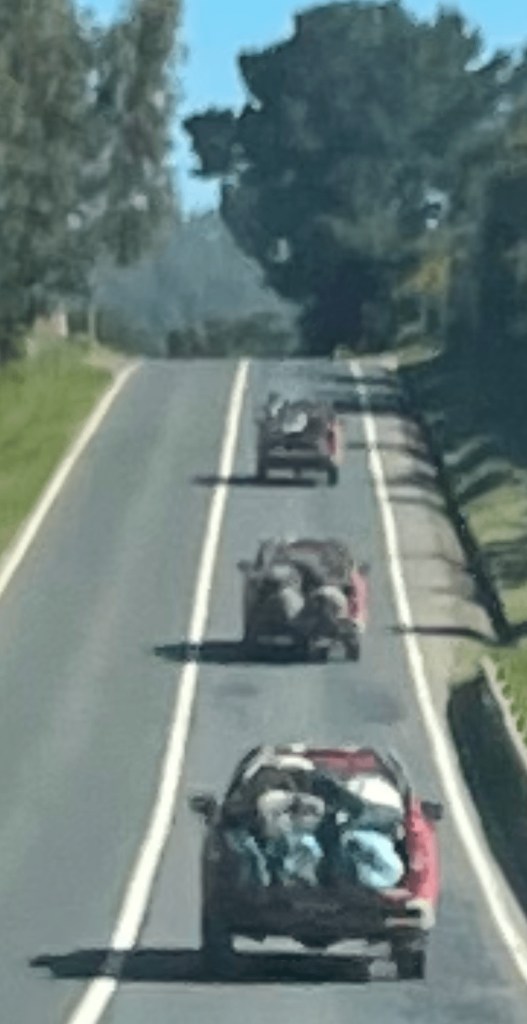
I arrived mid-afternoon to find three fire-engine red trucks lined up on the otherwise deserted beach disgorging all manner of windsurfing, kitesurfing and wingfoiling equipment. They were from Wales, all locals to Rhosneigr, one of my planned stops (see Where Next), and were just finishing a good session, so I rapidly rigged and threw myself into the sizable but gentle waves. The wind didn’t last, but I tasted the potential. The next day, the wind raged.
I stood on the beach next to my board and sail, watching the water being torn apart by the wind, spray flying off the dessicated ocean undulating with a big swell, and asked a local windsurfer, who was taking a much-needed break, when he thought the wind would die down. He smiled, looked at my too-big sail, and said it would be like this all day. And so the stage was set for some exciting, arm-wrenching wave sailing, overpowered but enjoying the luxury of “safe” big wave sailing.
This was the second time in a week windsurfing in 4m plus (13ft) waves (see Riding Big Waves). This time was almost enjoyable. As always, the main challenge in big waves is getting out through the whitewater so you can catch waves to ride in. The waves were big, maybe even bigger, but different than last time. They were more spaced out (a longer period) and they broke more slowly, more predictably. You could see the wave build far in the distance, see its peak form, see it begin to break, and be somewhat sure about how it would unfurl, left and right, leaving you time and room to go around. On the way in, you had more time to pick where to drop into the wave, more time to make your turns, and the wave would almost never break in front of you, letting you connect bottom and top turns for hundreds of yards, with the breaking whitewater safely behind you the entire way. Very fun indeed!
I also had the company of my new buddies from Wales, including one of UK’s top wave sailing champions, and a group of Argentinian windsurfers, regular visitors to the area. All in all, the experience was more like a fun day at the beach than the fear-ridden anxiety I usually feel sailing extreme conditions in a new location. Unsurprisingly, camaraderie makes this solitary sport more enjoyable.
The bigger challenge ending up being the wind. It roared, and the only place I could find respite was riding a wave, nestled behind a two storey wall of water. Of course, you then had to worry about the whole thing coming down on top of you. After an hour, I was done, but Tirúa was not done with me.
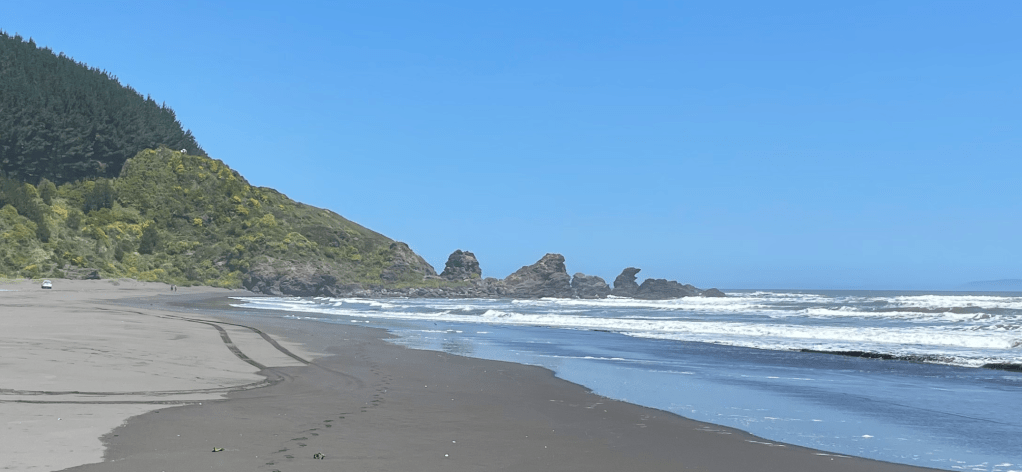
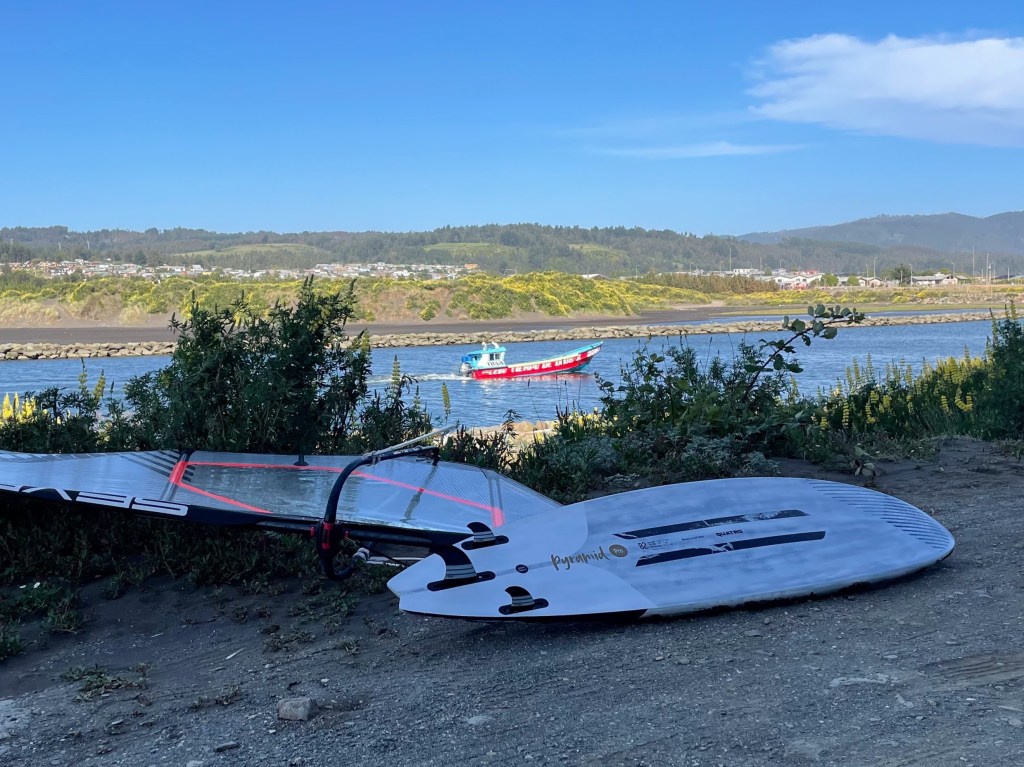
Tirúa bay is a scenic stretch of dark sand ensconced between a tall rock outcropping to the south and forested hills to the north, split by a rivermouth carrying local fishing boats to and from the village that lay behind the low dunes carpeted with long grass and wildflowers. The wind and the waves run from the south to the north, pushing a powerful current across the rivermouth. After enjoying some of my longest ever wave rides, I was caught by a mistimed wave on the way out and endured one of my longest ever swims.
Like many accidents, you typically know something’s going to go wrong well in advance. Premonition screams but your mind doesn’t listen. Sailing back out after a short ride on the south side of the bay, I was sailing fast in the strong wind, looking out for the waves coming in. Ahead, a big wave started to break all at once, not slowly like the others; it walled off the horizon with no reachable exits. I had two bad choices: turn quickly to outrun the whitewater back to the beach, but risk a fall and being buried, or push forward and make it over before the wave collapsed. I made the wrong choice, tightened my body, yanked my sail, drove my board hard and fast towards the increasingly dark face of the incoming wave. With enough speed, you can make it over almost any size wave, so I went as fast as I could. As I climbed the vertical wall that was now pitching over at the top, I realized that I was heading straight up at high speed in strong winds off a 4m ramp. This might have been exciting for a champion wave sailor, but was unknown territory for me. I bailed as I launched off the top, let go of my sail, kicked my board away, and dropped cleanly onto the back of the wave, in time to see my gear fall the other way, swept up by the whitewater hurtling towards the shore.
Everything looks that much bigger when your eyes are at water level. Left behind in the churning, foamy water, the air eerily still, I felt very small treading water, waiting for the next wave to break. And it did, and I pushed myself under, and I was still tossed around but popped up. My equipment was now out of view, as each wave pushed it further away. It was time for me to start swimming. I struck a steady, slow rhythm, mindful of keeping enough breath for each wave that swept over me, rolling me. Far ahead, I saw my sail pop up as it tumbled onwards. It was already on the other side of the bay. At one point I saw the rivermouth sweep past me and realized I was caught in the current, felt uplifted that I was going to reach my gear quicker, and then downcast when I realized that my gear was in the same current. Eventually, near the beach, the whitewater became smaller, the current weaker, and I finally reached my gear, properly exhausted. Now I was really done.
The next day was windless, and the following day was one my favourite wave sailing days ever, with decent wind and perfectly sized, well shaped waves making for long rides and only a few others out enjoying the glorious sunny afternoon session.
In travel, as in life, I enjoy the journey most. If the destination is good too, that’s a bonus. On this trip I hit the jackpot. Some favorite moments: taking a break on the beach, in my wetsuit, alone, with two village dogs sitting beside me, keeping me company; lunch in a two-table hut with no menu, custom ordered in poor Spanish; dinner around the kitchen table with windsurfers even more passionate than me; an Aperol Spritz (even here!) on the hotel deck overlooking the river, the bay and the village; and that perfect wave, many of them.
 F4 Plus