Topocalma, Topo to the locals, has an almost mystical reputation in windsurfing circles. It’s a super fast, super clean wave that gets super strong gusty cross-offshore winds, sometimes to devastating effect when the waves are big. At the end of a tortuous drive it’s often not sailable, but on a good day the wave is simply the best in the world. It took me three times to make it work, and I ended up getting exactly what I deserved.
The beach, which is on a vast expanse of private land, is only 10 miles south of Matanzas as the crow flies and takes over an hour by road, or what passes for a road. The winding, mostly off-road piste takes you through steep ravines, woods, prairies, streams, makeshift bridges, and miles of deeply rutted dirt. When you finally arrive, the place is magical.

Half the trip is on a paved road, but that only offers the illusion of comfort. The roads in this area are pock marked with manhole size potholes capable of stopping a car. Driving these roads requires the dexterity of a teenage video gamer. You are constantly scanning ahead to spot the holes, often hidden in the shade of roadside trees, and you have a single second to make a decision: slam the breaks so you gently drop in and out of the hole, or swerve into the other lane to avoid it. Often the car can straddle the hole, but they’re rarely alone, so you end up tracing a swervy line between them, tyres tighropping the edges, thankful the narrow roads are mostly empty. A working strategy is to closely follow a local car, since the holes appear to be a permanent and accepted part of the landscape.
I did hit such a pothole a couple of times, at speed (well, 30 mph or 50 kph, which is about as fast as you can make the curves). The wheel hits the far side with a bone-jarring crack (it’s much more than a thud), a sort of electric shock shoots through my tightly clasped hands, my jaw clenches against the impact, and my scalp tingles with dread, hoping the tyre doesn’t explode. My experience is not unique. In every village you can find a “Vulcan” sign posted on a freestanding tyre, with an arrow pointing to a shed. Vulcanization is a chemical process to fix punctures, and puncture repair shops are as popular as petrol stations back home (which are not at all common here, leading to some stressful consumption calculations in deserted areas… a different story).
The other half of the trip is not paved. This ranges from a decently hard dirt surface sprinkled with gravel and teeth-rattling washboard ridges, to a softer mix that has the wheels grasping from traction, to desperate trails that belong in the African Savannah. Some are designated for four-wheel drive only (the designation is always a hand painted sign on a rough wood board that a saintly passerby left as a warning). The road to Topo is not. In fact, at the entrance to the most gnarly section there’s a proud government sign proclaiming public access to the beach, a recent agreement with the owners of the surrounding land. The owners have done their best to make the place inaccessible in practice, if not by law.
I’ve driven that section six times now, three down and three up, and it’s painful. At some point on the endlessly bumpy trail, furrowed by sinuous ruts and ridges, the car was jumping around so much, the front bouncing wildly from side to side, that I actually laughed out loud, hysterical at the absurdity of this “beach access” road. It goes without saying that I drove that trail without meeting another car, even once.

A few miles down, the trail reaches a hacienda, with beautiful prairies stretching out to the coast. Horses and cattle graze in extraordinarily pristine landscape. There were signs of farming, some hay bales, an orchard, a corral, but all a piece with the natural surroundings, and few signs of any humans. Aside from nature, the place looks empty.
The final challenge before reaching the beach is a choice between a plunging stream crossing or a steep step onto a narrow worn wooden bridge that looks like it was made by lashing together some old two by fours. Having only a smallish town car (the four-wheel drive I had original rented suffered a puncture, ironically in the city, and was replaced with a two-wheel drive), I was not keen to be stuck in the mud, alone, so I opted for the bridge, successfully, but with my heart in my throat each time. My reasoning was that if someone takes the time to put up a bridge, there’s probably a good reason.
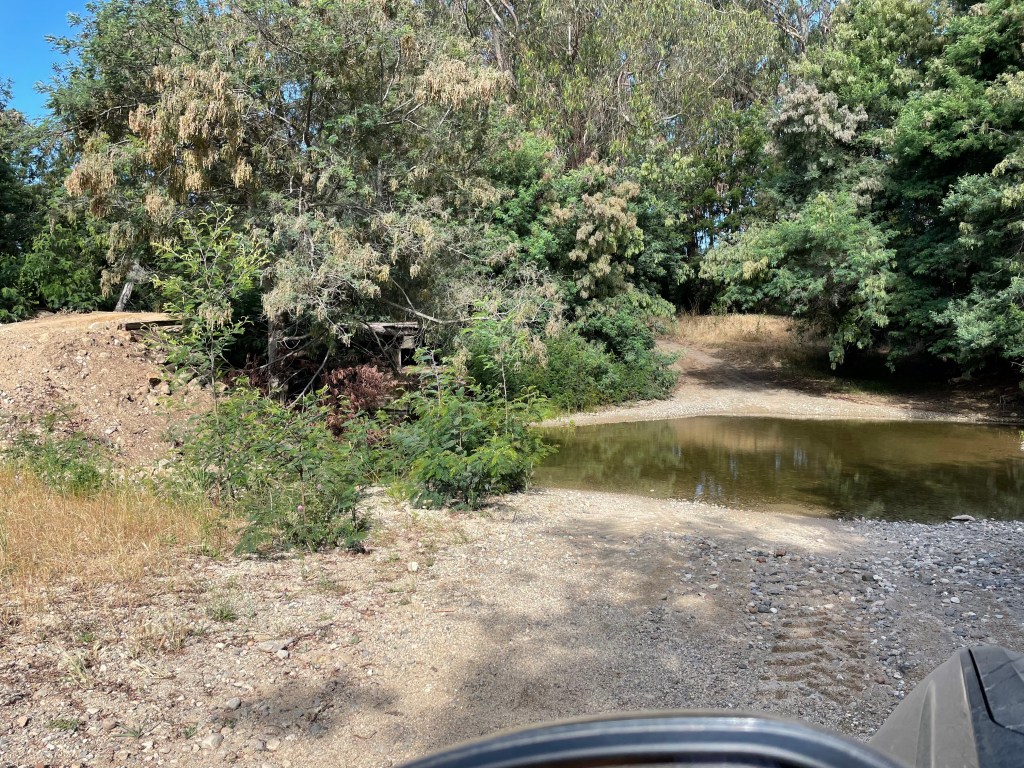
The end of the trail is the beach. Simply, the dirt becomes sand until the car won’t move anymore. Four-wheel drives can plow on, and do, driving on the expansive beach to set up somewhere near the middle. I have only seen a couple of cars there and they were windsurfers.
I went three times. The first time I found the Welsh sailors I met down south (see Going South), and a group visiting from France and Switzerland, and a Belgium who had lived in Chile for 20 years, a typical international cast of windsurfers, but the wind did not make its forecast appearance. The second time, the wind was blowing but the waves were tiny, with no one on the beach or the water; sailing alone is not a smart way to get to know the place. And so it was third time lucky, but in the karmic sense, not perfect, but as it should be.
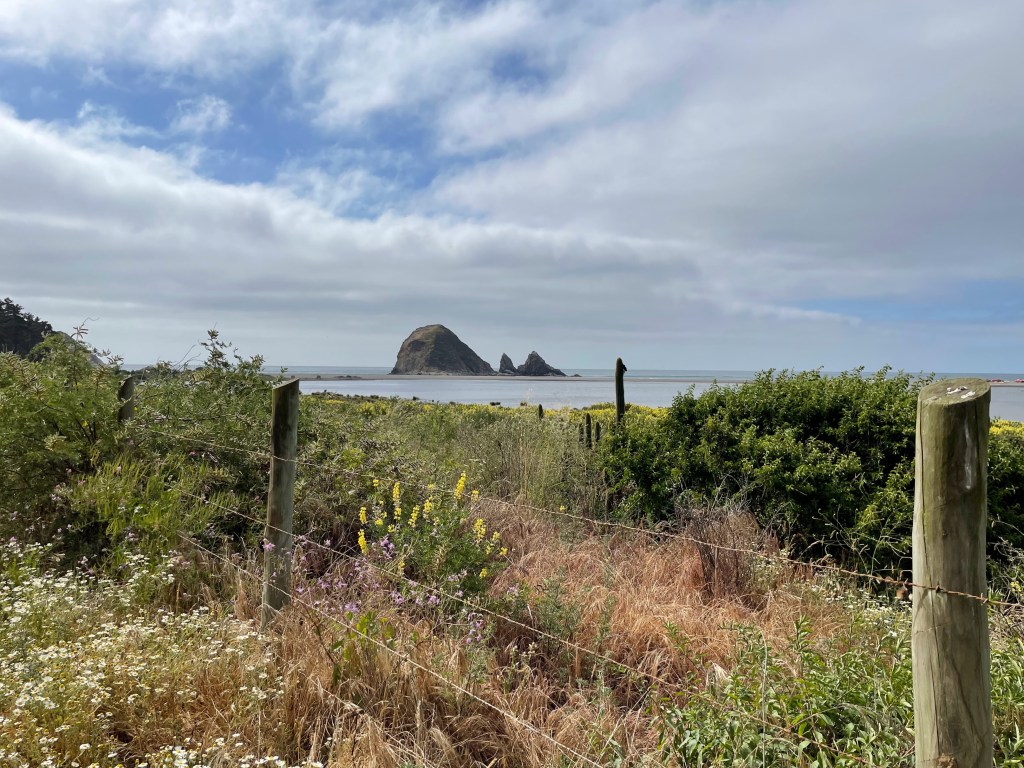
I’ve windsurfed since the age of 12, over 40 years. It’s always been a passion, and thankfully relegated to the back burner by family and work that have brought be more than windsurfing ever could. But passions burn bright, and whenever possible I let that light shine, sporadically, briefly, with the promise of one day being good enough. I was recently asked what that nebulous marker meant, and my nebulous answer was to sail comfortably in the world’s best wave sailing spots. I’m not there yet, but my journey (see Where Next) will get me there. I was certainly not ready for Topo.
The wind starts blowing at Topo early, around 10am, six hours before it comes into to Matanzas, only a few miles to the north. The strange configuration of the coastline also makes the wind stronger and more gusty. When it’s blowing, it’s really blowing, and can often be too strong in the afternoon. All of which I learned from a couple of regulars when I came in, dazed and confused from my short, blown-out session.
I arrived late (my car caked in dirt) after 2pm, to see a couple of trucks on the beach, in the distance, and a couple of very small sails peaking out of the waves. On my side of the bay, the bluff offers protection from the wind. A five minute walk to the water exposed me to its full force. The offshore wind (blowing from land to sea) hurled sand in long streaks into the water that was whipped into a frothy frenzy. The bay was a maelstrom of waves and whitewater, but nothing too big or scary. A hundred yards outs, the most perfect 3 meter (10 foot), pealing, freight train of a wave, a translucent deep blue streaked with crystal white, careened off into the distance. The perfect wave.
As I fought my way against the wind back to the car, I saw the remaining sailors come in, fighting their gear to the beach. One sailor remained, and he (I learned this afterwards) was very, very good. A young Spaniard half my age, two-time world youth champion and already in the top 5 on the world tour, riding the waves perfectly. Not wanting to go out alone, I rigged quickly and ran gear in hand, letting the wind almost carry me from behind, to where the other sailors had come in (now warming up in their trucks). The lone sailor was still out there, still surfing those perfect waves, seemingly enjoying himself. Out I went.
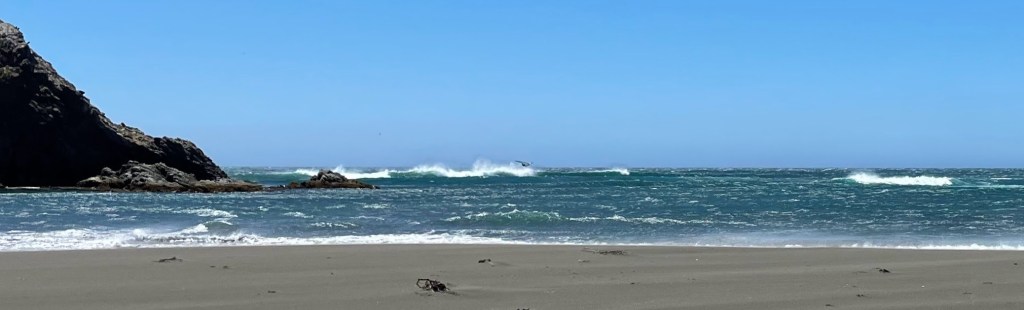
In a few words, I was blown over twice on the way out, pushed under by a couple of big waves, made it out breathless, was blown out on my turn, got back up shakily, looked down the shoulder of a Topo beauty unfolding right there in front of me, lined up my own decent size wave, nothing too big, felt the Topo power in how the wave unfolds, made three decent turns, nothing too great, was blown out the back of the wave, and sailed in, spent. That was it. That was enough. It took me twenty minutes to drag my equipment back to my car, against the wind, heavy step by heavy step, even more exerting than the windsurfing.
The experience was not what I had hoped for, but it was exactly right. I was there too late in the day, because I had not learned how the place works. I made it out because I was good enough, but only just. I surfed the famous wave, but only a smallish one. I can’t say that I’ve really sailed Topo, but I now have an appreciation for what that looks like, my own marker for reaching my goal of sailing comfortably in the world’s best wave sailing spots.
And for a brief moment, I sailed alone with a top windsurfing talent in incredible wave sailing conditions. This would be akin to teeing off the 6th hole at Pebble Beach (I’m not a golfer, I looked it up) with an up-and-coming Tiger Woods, just the two of you. You’re off hacking in the undergrowth (or at least I would be) but you have a close-up, in-person view of how the game should be played. Not a bad consolation prize.
 F4 Plus