I’m back in the Southern Hemisphere looking for perfect wind and waves. On day two of my trip, I found them in Margaret River, Western Australia.
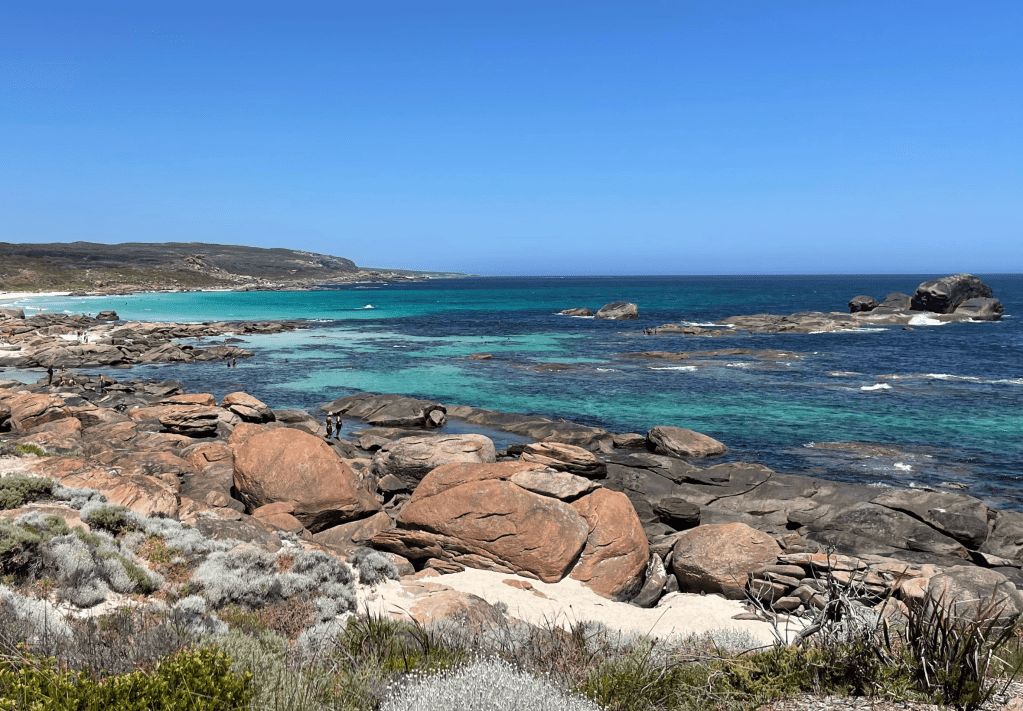
It takes a minute (I’m trying out this new colloquialism that I picked up in California) to get here; 40 hours door to door with over 90 kg (200 lbs) of luggage and gear. I can build quite a castle on a luggage cart. If you’ve been following my journey, you could be forgiven for thinking that I’m on a wine tour instead of a windsurfing quest. From Central California to Central Chile to here, all renowned wine-growing regions. This arguably leaves out only France and South Africa, which are on my itinerary as well. Clearly, wine and wave sailing share similar climate requirements. Lucky me!
Margaret River has the same windsurfing configuration as Matanzas, which inspired Part 1 of this article, and it’s also completely different. Both are located on remote and picturesque coasts. Both get afternoon side shore winds from the south that build in the afternoon, and strong waves that break left for goofy foot surfers like me (see Windsurfing Theory). Both attract sailors from around the world, many settling permanently.

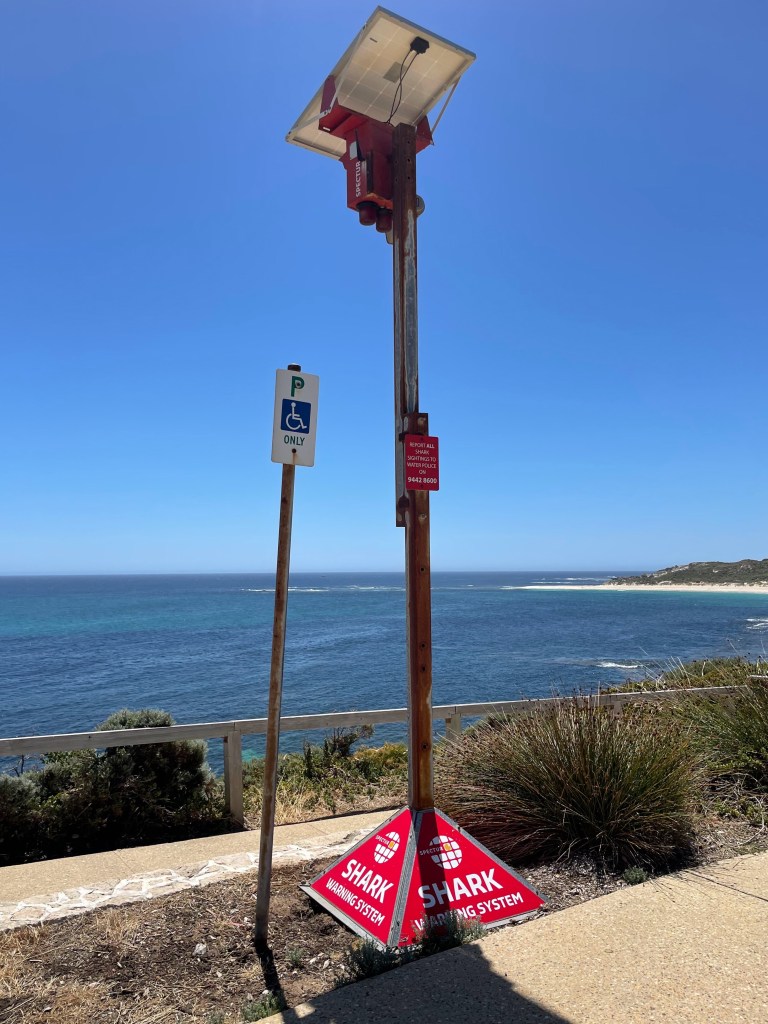
Margaret River also comes with exciting upgrades. For one, it’s a top surf break in a surf-crazy country (the beach is called Surfer’s Point), which means a significant investment in infrastructure for visitors and spectators: pristine roads and parking, manicured lawns for lounging and rigging, water fountains and showers, slip-proof stairs to the beach, and even a handy-dandy shark alarm system for those pesky predators (I’m not sure I feel safer knowing they need an alarm to begin with). And then there’s the weather, clear and dry and hot, but not too hot, just enough to tan the skin and warm the bones. While Matanzas felt raw, Margaret River feels plush, at least until you get in the water.
The water’s much warmer, which is nice. I was comfortable in a thin wetsuit, lighter and easier to wear than the cold-weather armor needed for Chile. Less nice is that the entire break is a limestone reef, and a thin layer of rubber feels somehow insufficient when you’re being dragged over sharp rock by a sadistic wave. Waves that break over reef (a reef break) confer a lot of advantages over waves that break over sand (a beach break). More power because the seabed rises suddenly instead of gradually like a sandy bottom. More precision, because the shape of the reef molds the wave so it breaks in the same place every time. More options for getting out because the reef usually comes with deep channels or only extends across part of the beach. But reef breaks are also more painful when you fall. Even a light bounce off the bottom can cut. It’s a trade off between a better wave and a softer landing. The most famous surfing waves are reef breaks: Cloudbreak (Fiji), Pipeline (Hawaii), Nazare (Portugal). Matanzas was a beach break and I was very, very thankful for it.
Still, I have wave sailed over reef before (Caro in France, Silver Rock in Barbados, Spreckesville in Maui, One Eye in Mauritius) and you quickly adapt, avoiding the shallows, staying high on the wave, watching out for boils (they mark outcroppings), and never kicking your legs when moving around in the water.
The Margaret River beach is quite small, and the reef is everywhere. My first challenge was to get out without damaging my fins and board, or myself. In my excitement, and still reeling from 13 hours of time zone difference (an almost perfect schedule reversal), I showed up early to the beach before anyone was out. A local kitesurfer who was unloading his gear helpfully pointed me to the Keyhole, a narrow channel surrounded by shallow reef and churning water. I waited for him to rig and lead the way. I followed. It worked and I was able to get my first taste of this famous wave.
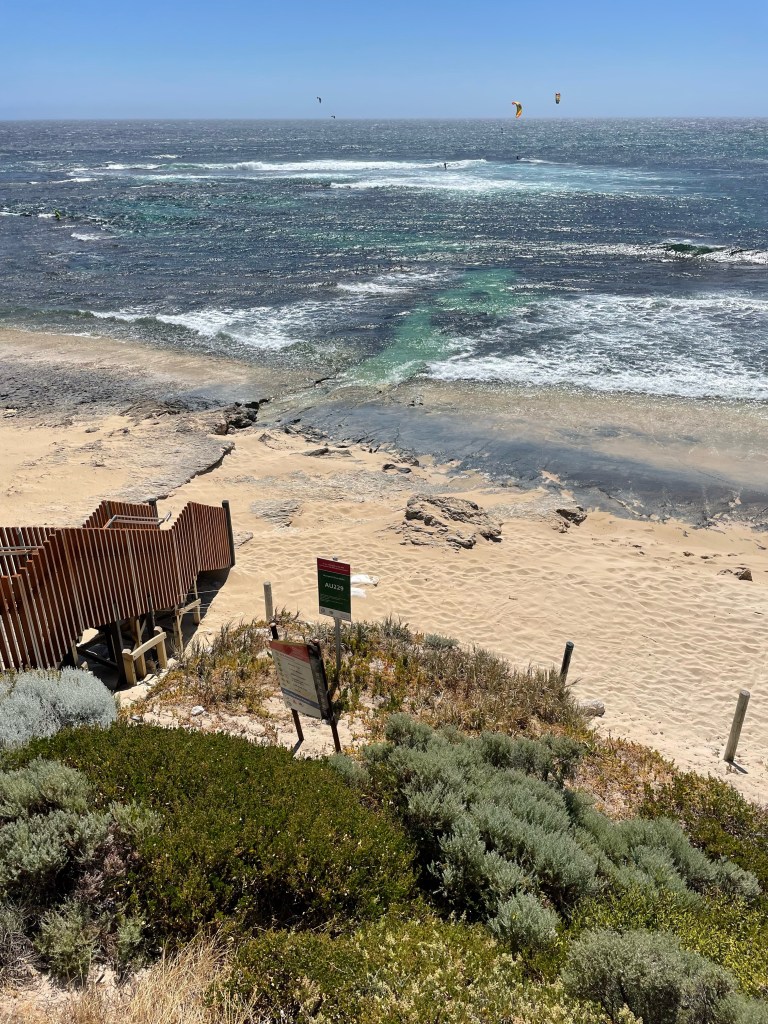
I’ll start by repeating what my friendly local told me when I asked him for help, “well it looks bloody flat today, mate.” It did not look flat to me. In the sets the waves were way overhead. I think his point was that it gets much, much bigger. I was thankful I was starting on an easy day and, truth be told, the wave was indeed very easy. Sometimes big, with the reef always uncomfortably close, but somehow safe. A perfect introduction.
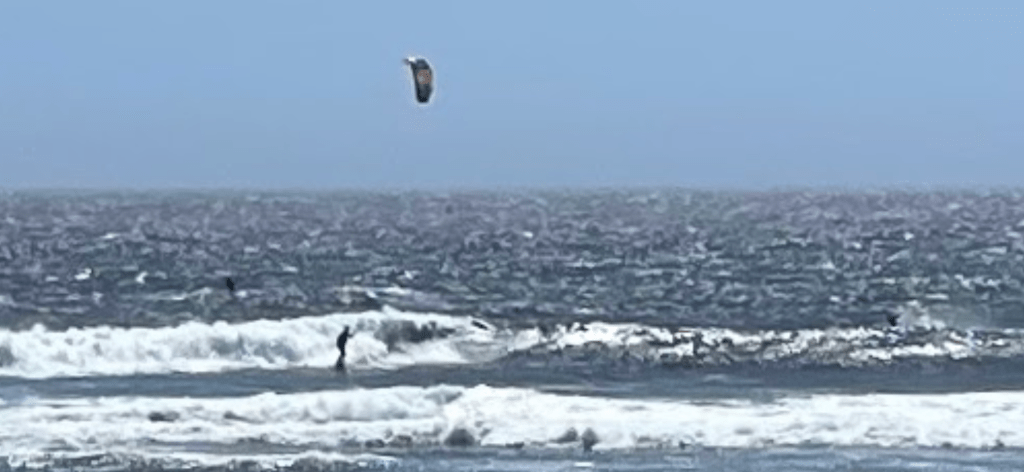
If you’re interested in how it feels, read on. Unlike Matanzas, the wind blows strong all the way to the beach, so I had plenty of speed to push through the oncoming waves. Even better, also unlike Matanzas, the wave only breaks in a specific area, where the reef is shallow enough, with miles of deep water off to the side to escape to. Basically, if you wanted, you could sail through deep water around the waves, head upwind to get behind the break, turn onto an incoming swell, wait for the swell to catch the reef and pitch into a wave, surf the wave all the way to deep water, kick out and go back out without ever touching whitewater. That is indeed what I wanted. By the third wave, with still just me and the one kitesurfer out there, I let out a scream of joy (literally) because it was so good.

Catching a wave here is child’s play. The swell is bountiful and the takeoff point, where the wave starts to break, is perfectly consistent (thank you, reef). Just pick a swell, line up and wait for the wave to form. On this calm day the wave pitches gently with plenty of time to admire the dark ominous reef through crystal clear water as the wave carries you high. And then drop into the bottom turn, read the rest of the wave unfolding ahead and slice a couple or half-dozen top turns as the whitewater thunders behind. On the last turn, the wave gracefully dissipates into deep water. Look back and the next wave is dissipating too, clearing a path for the sail back out. Could it get any better?
I know it’s not always going to be this easy. My friendly local described the break as gnarly when it’s bigger. It would need to be much gnarlier (I’ll try this word on for size as well) to match Matanzas. We’ll see. I’m looking forward to finding out what this amazing wave can deliver, and to post a Part 3 to this article.
 F4 Plus