Please accept this article as a mea culpa for my hasty vilification of this noble, royal passtime. I now know better.
My windsurfing quest continues in Hawaii, on the island of Oahu, in Waikiki, where kings and queens have surfed for hundreds of years. This seemed like a good place to learn how to surf properly. The first half of my trip was “cursed” with winds too light to windsurf (more on that later) and I was “forced” to enjoy the ocean another way. None of this is terrible. Armed with a $80 surfboard from a friendly local and my rudimentary surfing knowledge, I confronted the fearsome Pacific swell.
The Hawaiian swell can indeed be daunting, but not in Waikiki, home to the easiest, gentlest, most forgiving waves in the world, and where every Tom, Dick and Harry (and Morgan) can learn to surf safely, which makes for truly daunting crowds.
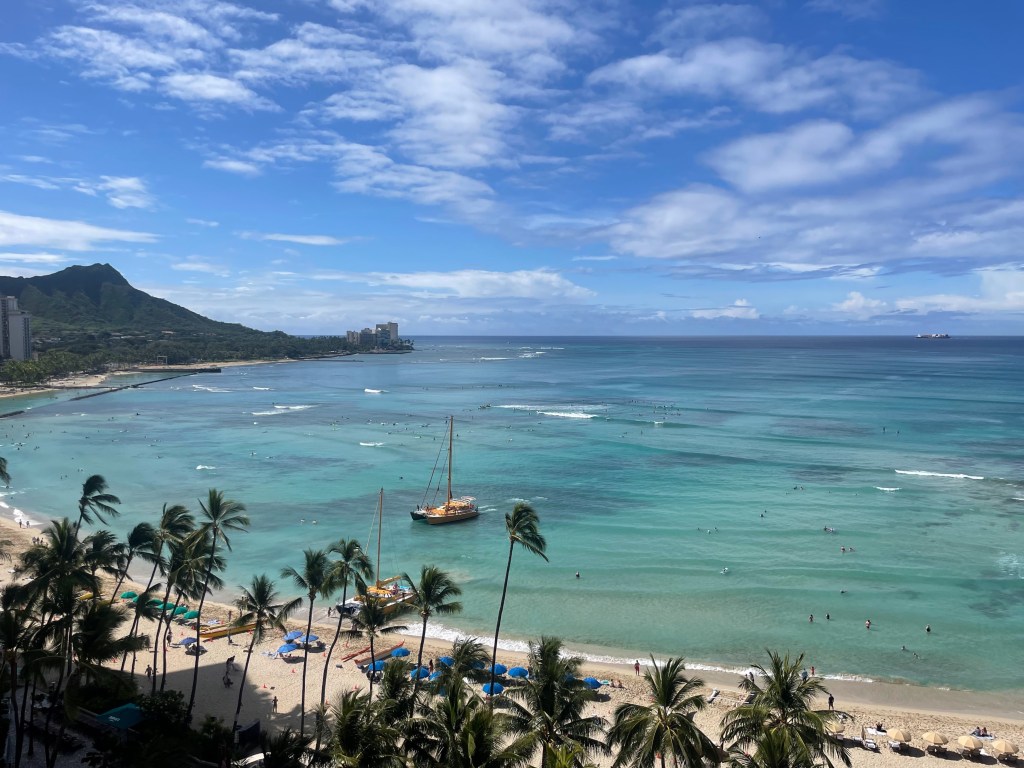
First a little about the break. Waikiki is a collection of reefs and sand bars that catch the smallest of waves but also temper the big ones. The glorious result is half a dozen surf breaks that deliver quality rides 24/7 and rarely get much bigger than head high. Of course, most people come for the perfect beach, which arcs around the breaks for almost a mile and is permanently teeming with tourists, some of the 10 million that visit Hawaii each year (half the number for London and Paris, but in a much smaller area, and baring a lot more skin) to enjoy the perfect weather, a consistently sunny 82F (28C) with a light breeze. A not-so-small contingency of these beachcombers ends up grabbing a rental board to tentatively try their luck in the waves. The result is pure bedlam, and a true test of social etiquette.
It’s not just the tourists. Waikiki has a strong local surf culture and lays claim to the longest surfing heritage. Someone carrying a surfboard is so common that you soon don’t notice them on the sidewalk, at the stoplights, in the side streets, in the parks. Even the local fire trucks sport a surfboard, though I’m not sure why. It seems that everyone is a surfer, all shapes and sizes and all ages. Tans, bikinis, board shorts, and flip flops are the only attire needed. It’s an incredibly easy experience. At least, until you get into the lineup.
Surfing rules are well established: the surfer closest to the peak (where the wave breaks first) always has the right of way, one surfer per wave (or one going each way), respect the other surfer’s position in the lineup (where surfers wait for waves to break), don’t get in the way while paddling back out, always wear a leash and hold onto your board (lest it becomes a dangerous projectile). Sound advice honed over time. None of these apply in Waikiki. Most don’t know; the rest don’t care. The ones who do care, the hardened locals, will let you know, often brutally, but given the sheer number of people milling around, many seemingly aimlessly, this is definitely a place where doing any surfing requires asking for forgiveness, not permission.
Nevertheless, the Waikiki lineup has an established pecking order, just like every other surf break in the world. Most of the breaks here, the best ones, are locals only. Some are a long paddle out, others break on a shallow reef. Either way, tourists are advised to steer clear. The main break is Canoes, dead center to the beach, smack in front of the first hotel ever built here, the Moana Surfrider, a break enjoyed by seasoned locals, eager visitors and hapless first-timers, and the occasional outrigger canoe, a particularly unforgiving wave riding companion. Canoes is where I surfed.
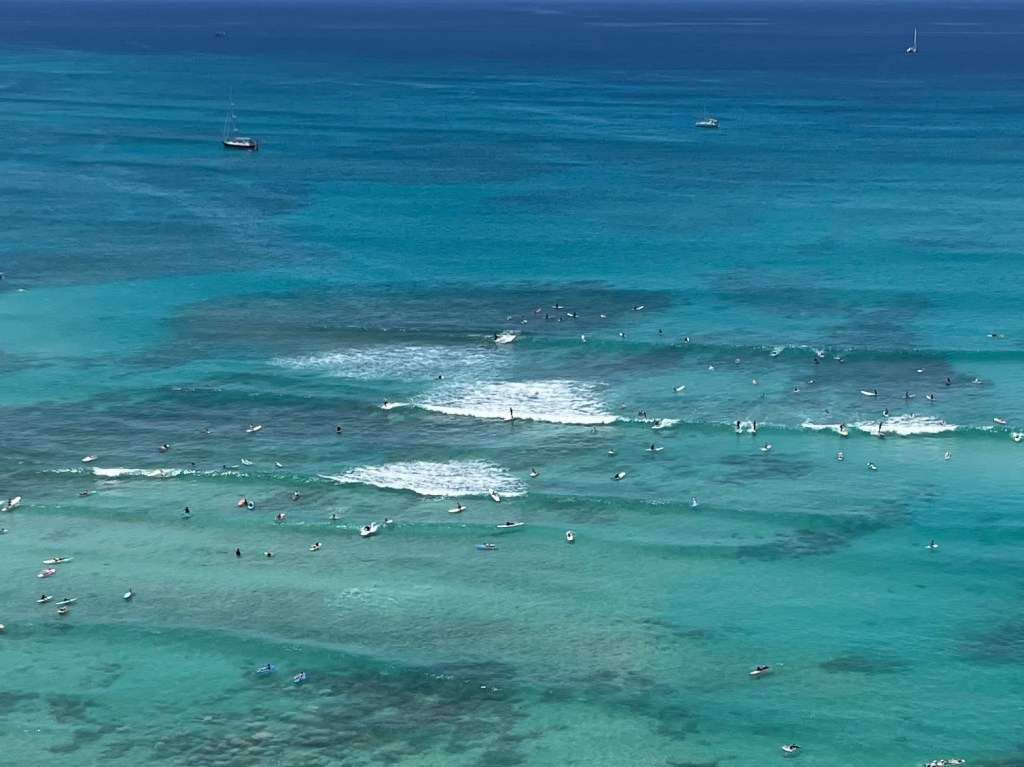
Canoes has two peaks. The better one, which breaks first and biggest, is on the left (looking from the beach). That’s where the locals hang out. The second one, on the right, is for everyone else, creating a long line of wannabe surfers between the two peaks who, with time and misplaced confidence, edge closer and closer to the left. That was my journey too, and I’m pleased to say that after twenty or so sessions I was squarely on the left, among the annoyed locals.
Catching a wave at Canoes is both easy and hard. Easy because the wave builds steadily from afar and breaks consistently at the same place, practically picking you up in its soft hands to place you comfortably on its watery shoulder. Hard because you’re doing it with twenty others. Recalling a scene from Gladiator, most don’t make the initial drop, bodies plunging, boards flying, whitewater churning. But if you make it, deftly avoiding all of the above, you’re left standing with five or more others, forcing you left or right, or hemmed in on all sides, locked into a straight line.
And that’s without even considering the surfers paddling back out, or, more often, only pretending to paddle, or lounging, or socializing. And that’s where the magic happens! Imagine catching a wave, shooting down the face, looking up and seeing ten, twenty, thirty paddlers blocking your way. You weave, they bob, and somehow, magically, no one is hurt, the wave passes, and the next one rolls in. It just “works” and it’s a sight to behold. Everyone ends up in the water, clinging to their boards, smiling, saying sorry, thank you and are you OK, genuinely enjoying the moment, exhilarated by the experience (even the locals). This is not unique to Waikiki, but it certainly warms the heart and heralds hope for humanity.
And so I learned to surf, properly, at Canoes, how to paddle efficiently, how to turtle my board under an oncoming wave, how to take off cleanly, further forward on gentle waves, further back on steep ones, how to ride down the line, “essing” up and down to generate more speed. This was not without pain. I sprained both my shoulders early on, a constant irritation for the rest of the trip. I was flipped by a few locals (while riding side by side, they grab your board and flip it), and cursed out once (I flipped one back). It was physically exhausting, especially on bigger days battling the whitewater, when you seem to spend more time going backwards than forwards. And I often paddled into and missed several waves in a row, ending up breathless, furious and in the middle of the impact zone, with nothing to show for it.
Still, I learned, and eventually it was time to graduate out of the Waikiki kindergarten of surfing and onto what could actually be classified as real-world surfing, my home break. At the risk of sounding like a real estate agent, my AirBnB, my home in Hawaii, was a lucky find. The studio apartment is located a little less than a mile from Waikiki, separated from the touristy hustle and bustle by tree lined parks that follow the coastline east up to the base of the majestic Diamond Head crater, in a cluster of 60s buildings built when you could still build on the beach. Gloriously isolated and abutting a quiet residential neighborhood of multi-million dollar homes, my studio is on the first floor (one floor up from the ground) overlooking the ocean, so close that you can barely see the beach in between, with a bay window that spans the entire sea-facing wall and opens from corner to corner.
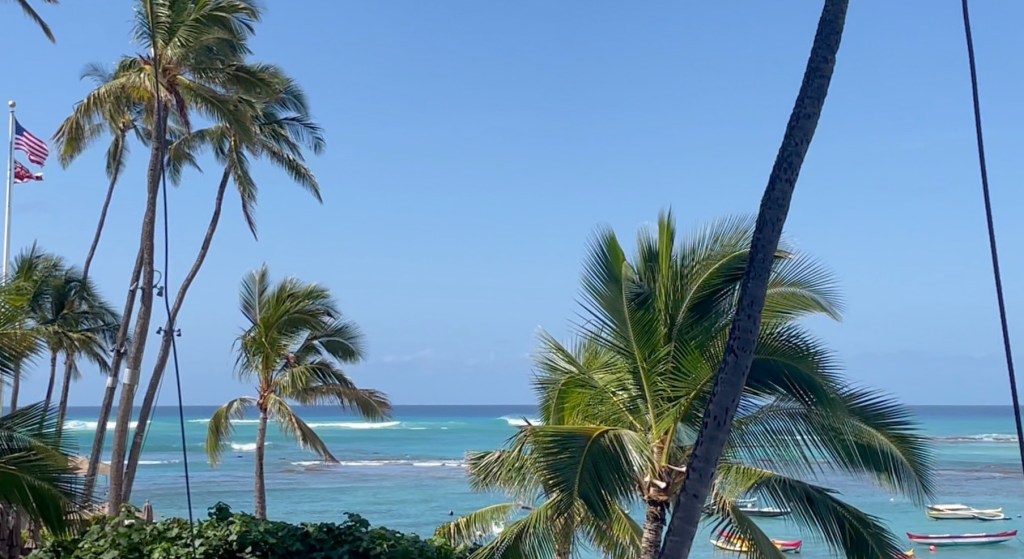
The foreground is strewn with colorful outrigger canoes tugging at their moorings, part of the rowing club next door. The middle is dark from the reef, shallow enough to be dry at low tide. Beyond, the colors turn to various shades of deep cerulean blue where, a short 200 meter paddle from my front door, waves peel into brilliant white streaks. The break works on most days, groomed by a near-constant offshore breeze, with usually only a small dozen co-residents in attendance. Like most real-world breaks, it’s not perfect. It needs a slightly bigger wave to break cleanly, head high and over is perfect, otherwise the wave tends to pass under you. And the end of the ride ends uncomfortably close to the reef, so you want to bail early. But you really can catch some great waves, unfolding cleanly and quickly for your riding pleasure, amid a genuinely familial ambiance.
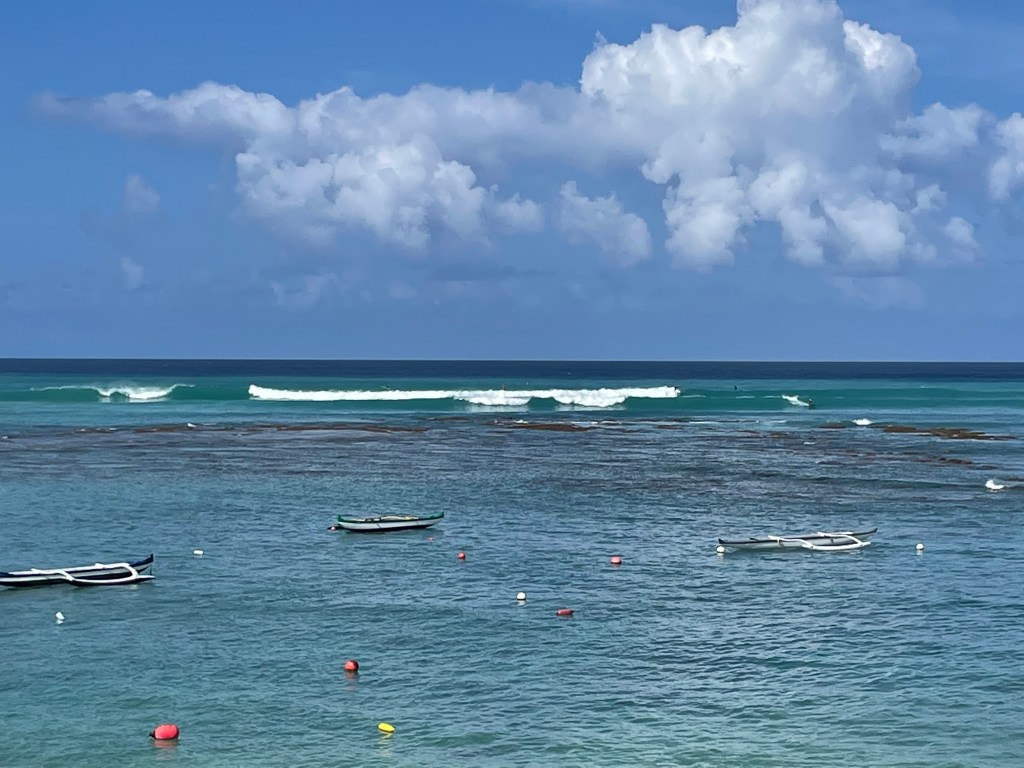
And so I watch those waves come in from my window, watch the surfers catch them, and when I’m ready (and the wind is too light to windsurf), I don my shorts and grab my board and make believe for a moment that I too am a local.
Of course, the real surfing action happens on the north shore of Oahu (simply referred to as the North Shore in the surfing world). Renowned for its high quality waves and home to many of the top surfers and the most important surfing competitions. A dozen hallowed breaks lay side by side along a few miles of country road: Sunset Beach, Rocky Point, Pipeline, Log Cabins, Waimea Bay… None are for the beginner, or even the intermediate. You have to earn your place here. For an idea of what that takes at Pipeline, I recommend The Ying & Yang of Gerry Lopez (who was also quite a good windsurfer in his day). Too much for me. I have my own mountains to climb, and they’re not these.
 F4 Plus