There is one place in the world that I’ve wanted to windsurf since I learned at the age of 12, a place I knew intimately only from magazines and that I then visited dozens of times but never sailed, a place known worldwide as the heart and soul of the windsurfing community: Ho’okipa Beach Park, Maui, Hawai’i.
Partly, I hadn’t sailed it yet because it’s challenging, but no more than Matanzas or Margaret River or One Eye in Mauritius, all places I’ve sailed before. Mainly, I hadn’t sailed it yet because it’s intimidating, because it’s the proving grounds for the world’s top professionals, all vying for the best waves and the best moves, and maybe, also, because it represents fourty years of expectations that I was afraid to lose.
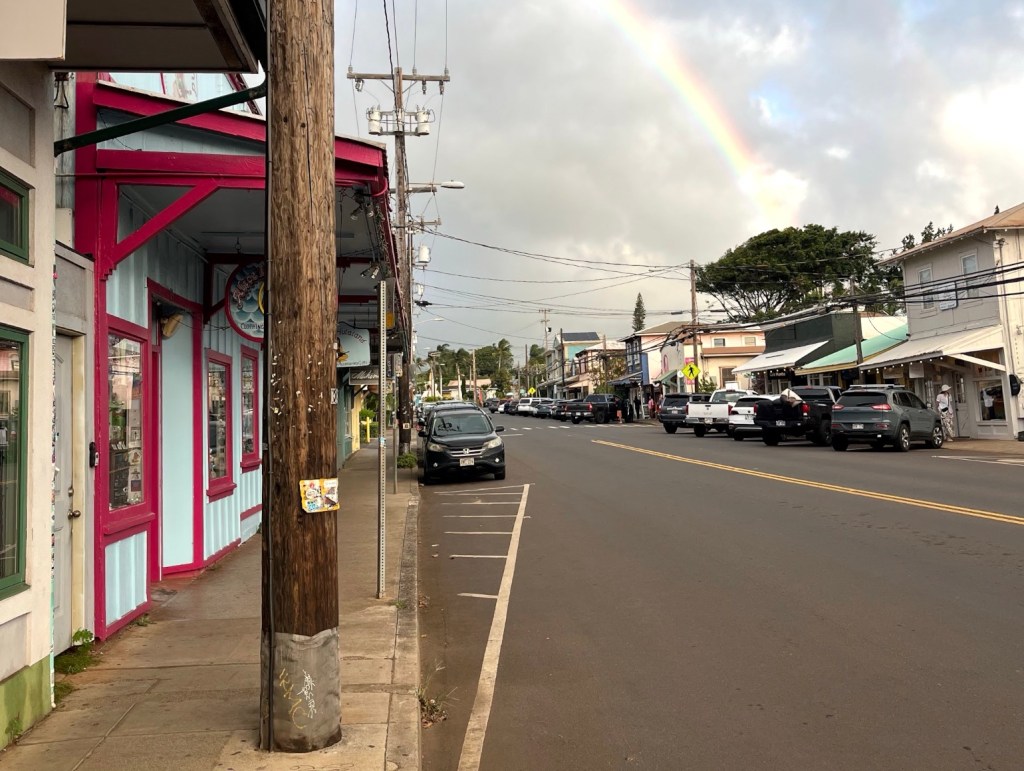
Last May I was invited to a birthday party in Cancun, Mexico. From Italy, that’s sort of on the way to Hawai’i, so I extended my trip by two weeks and booked myself into an Airbnb on the edge of Pā’ia, the small plantation era village on the North shore of Maui, down the road from Ho’okipa, where windsurfing grew up.
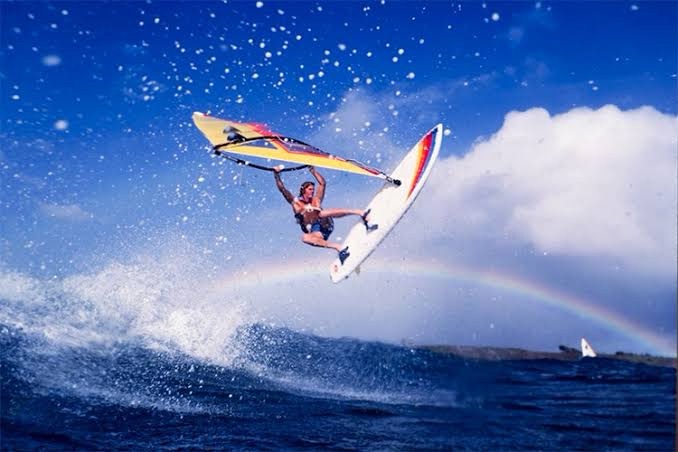
Windsurfing wasn’t invented here but this is where it went from being a light-wind longboard sport to becoming a high-wind shortboard sport. The pioneer was a young Mike Waltz, who moved with his family from Southern California to Maui at the end of the 1970s. Mike was one of the first windsurfers, friends with Matt Schweitzer whose father had recently patented and commercialised the original Windsurfer brand. In Maui, Mike discovered a surfing beach that combined a great wave and strong wind. He cut his longboard down to 7 ft (213 cm), removed the daggerboard and screwed in some foot straps. Wave sailing was born.
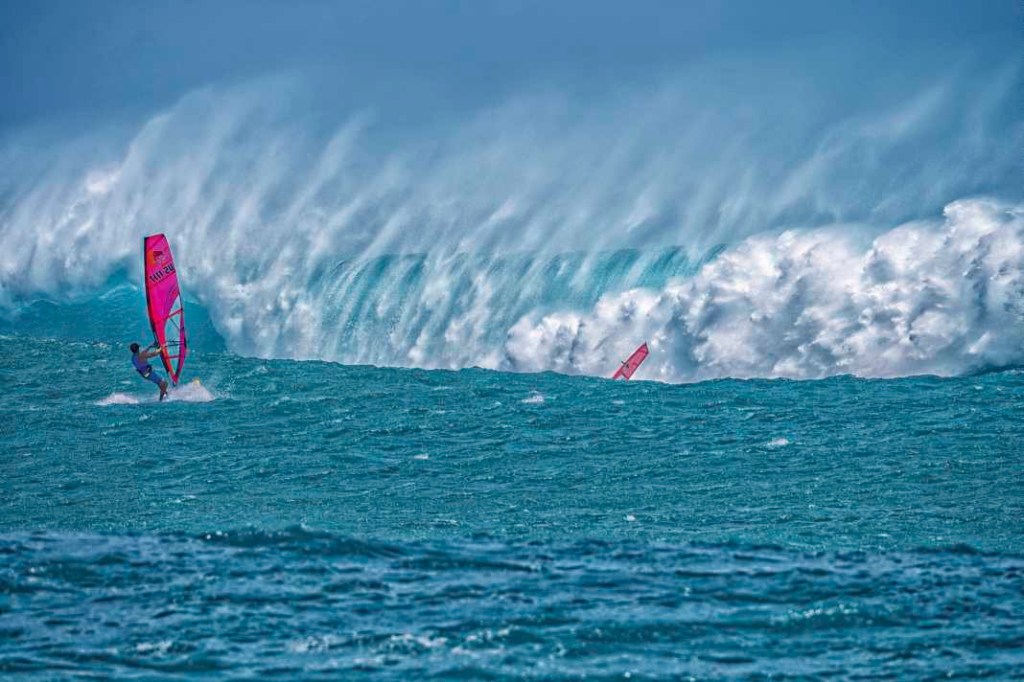
Soon every windsurfer was reading about the perfect waves and steady wind and Pā’ia become the center of the windsurfing world, where by the best riders lived and the most innovative brands set up shop. Beautiful images of beep blue waves and sunny skies on a backdrop of endless green sugarcane (Maui’s main crop until recently) were in every magazine all the time. The most important competitions were held in Hawai’i (also on the nearby island of Oahu, where the legendary Robby Naish would soon become as dominant an influence as Ho’okipa was). The best gear came out of Hawai’i, piggybacking on the surfboard building industry. We all dreamed of sailing there.
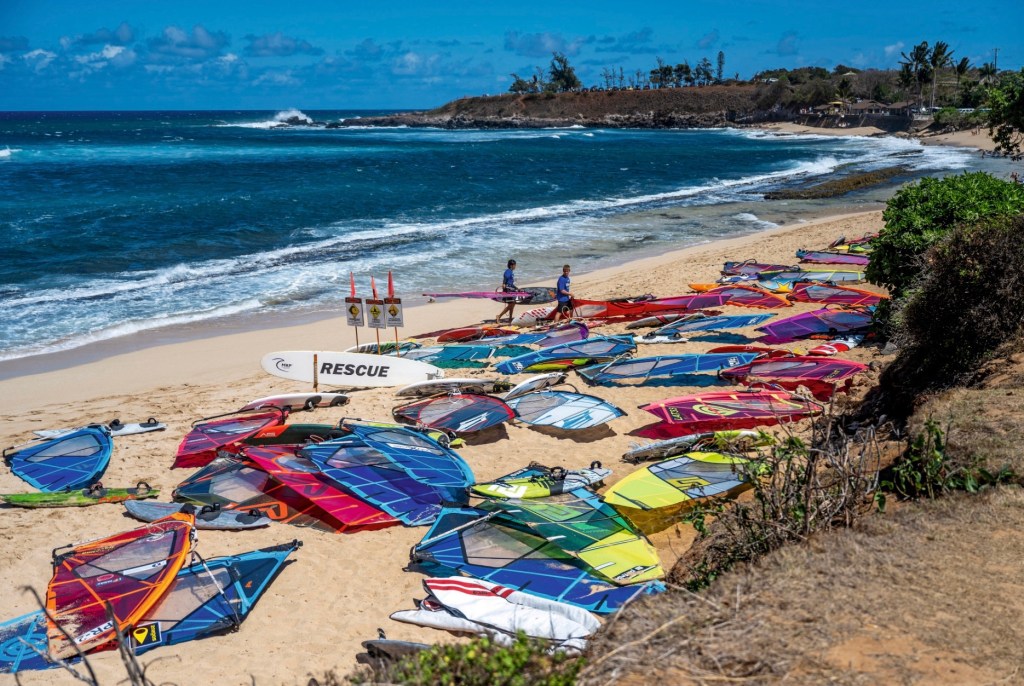
It’s not an easy place to sail. The small bay is hemmed in by a bluff that blocks the wind close to the beach. The beach itself is bordered by a sharp corral reef with only a narrow passage on one end from which to launch. On the right (looking out to sea) is the surfer’s wave, protected from the wind by the high bluff. On the left, more exposed to the winds, is the windsurfer’s wave. The waves come in big and steep, breaking over a shallow reef. The rides are not very long, maybe two to three turns, but they are fast, dropping you off close to the rocks that border the beach. The currents are strong and unforgiving. The bluff provides natural arena seating for the tourists driving to Hana and intrigued by the spectacle.
I had been in Maui 7 days, with 7 days of good wind and waves, sailing at the nearby beach of Kanaha, a wide open bay with mellow waves on a deep reef located at a safe distance away. 7 days of training to sail Ho’okipa. For my first attempt, I hired an ex-pro, Matt Pritchard, to help me. The day was overcast and the wind was fluky. The waves a little over head high and punchy. As Matt reminded me, it’s never going to be perfect, so we might as well go (something a pro might say). So we went.
Over the years of observing the place, from magazine pictures and when I had previously visited Maui to sail Kanaha, I had built up an irrational fear of the narrow launch spot. It had a bad reputation, with sailors ending up washed up on the rocks. On this day, following Matt’s advice, I charged in, jumped on and just held on until I was through. There was no room for doubt or hesitation or giving up. It was good advice; I made it through, then over the breaking wave and out.
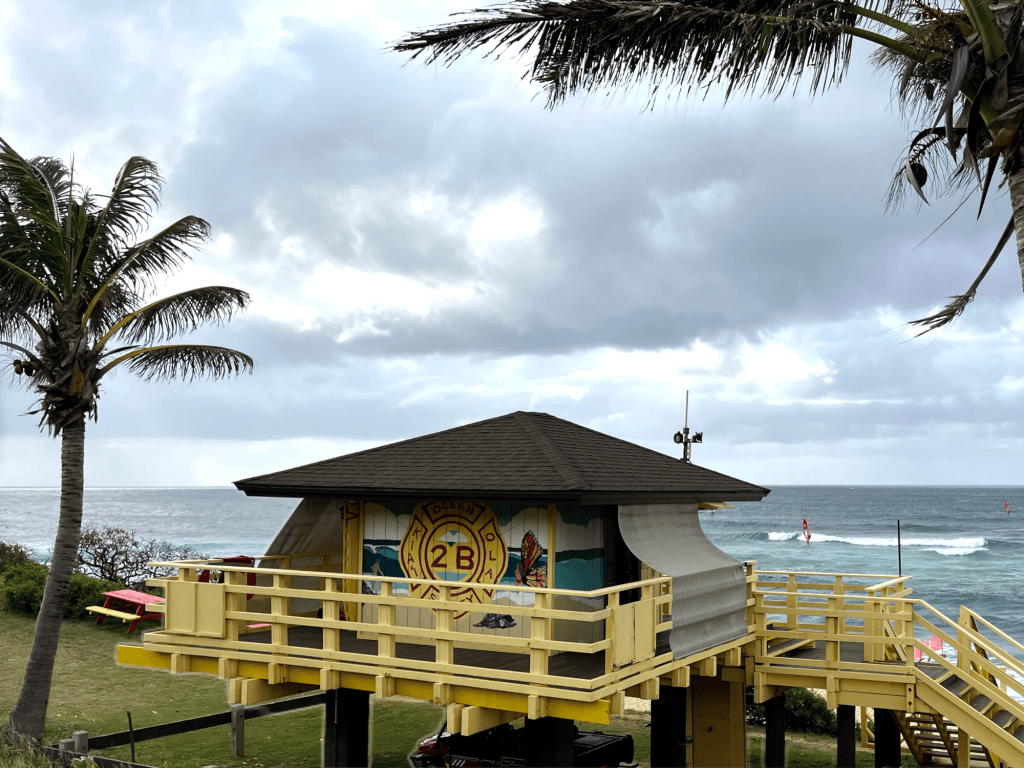
The ocean was steel grey to match the sky. The swell was steady and well spaced. Maybe because the wind was light, maybe because it wasn’t sunny, only a couple of locals were sailing, providing me with plenty of room to position myself. I was sticking to Matt’s tail, slowly beating a path upwind. He turned and I followed. He was spotting the horizon looking for a good wave. While we waited I looked back at the beach and at all of the so-familiar landmarks burned into my memory from the photographs: the palms swaying over the car park, the lifeguard tower, the rocks on the point, Mama’s Fish House all the way downwind, and the North shore coastline running West to the mountains on the horizon. I was seeing them all for the first time.
“Take this one,” Matt suddenly orders. I square off my board, wait for the swell to lift me, pump my sail hard, and I was on. The wave rises rapidly behind me, peaking above my head. I drop into a bottom turn down the line, carve up to catch the lip, swing around, one more and then I’m out the back of the wave, slowly making my way upwind to where Matt was. All in all, a very descent first wave at Ho’okipa, big enough, well executed, nothing crazy or too scary.
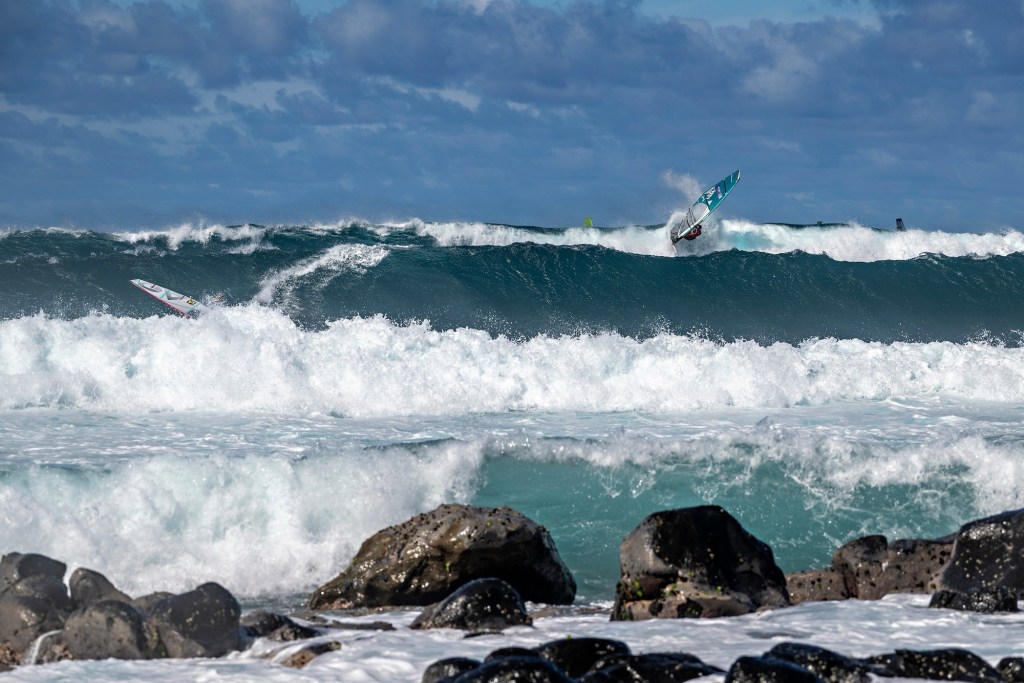
Overconfident, I grabbed the next one without Matt’s guidance. It was smaller, too small, and I chased it towards the rocks where it left me in the water, in the current with no wind. I quickly learned that the currents can be a huge help. Here they run parallel to the rocks, so unless the waves are big enough to carry you into the rocks, the current gently takes you around them. At some point you find some wind and can safely start the loop again. Still, being stuck between breaking waves and rocks is not a comfortable place to be and I was careful to heed Matt’s advice from then on.
The session finished quickly. I was physically exhausted, a mix of 7 days sailing without a break and the adrenaline from sailing here for the first time. I headed back towards the small launch area, planning to power through the beach break right onto the beach. Unfortunately, I undershot and ended up a few meters downwind of the gap, once again caught in the current along the rocks. I was too tired to sail out again, so I yelled out to Matt if I could just swim my equipment back in. I don’t think he’d been asked that before and he said he wasn’t sure. In the end, I swam in, not an elegant end to my first session, but probably appropriate.
Matt and I sat on the beach while I caught my breath. It had been an honour to sail here for the first time, and with a local pro. I was emotional, reliving the years of anticipation. After I packed up everything and was driving the couple of miles back to my rented home, a wave of immense relief swept over me, and I cried. Ho’okipa meant that much to me.
I toasted my first session with Rob, the owner of my Airbnb. He moved to Pā’ia in the 1980s to windsurf (that’s why people move here), bought an empty plot of land on the outskirts and slowly built a few houses. Rob regaled me with stories of sailing with my heroes. He knew them all. At the age of 71, he still sails Ho’okipa regularly (nowadays on a wingfoil). I hope to sail it again soon.
My 15 day trip to Maui ended up 12 days of windsurfing, 2 days of surfing, and only one rest day. No surprise that Maui remains the mecca of windsurfing.

